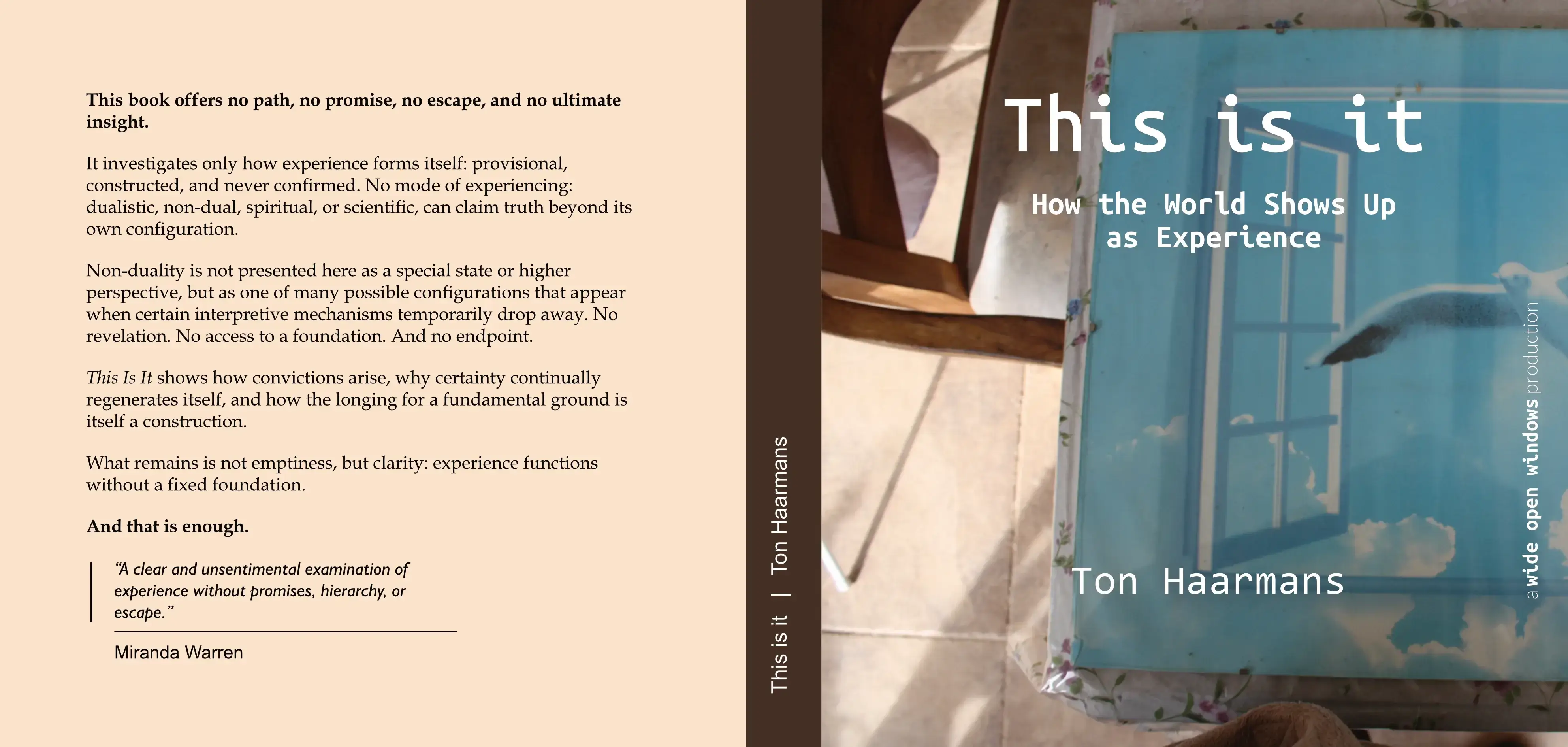
This Is It: How the World Shows Up as Experience is the first volume in the series Configurations of Appearance. The series explores different ways in which experience organises itself, without assuming that one of those configurations offers privileged access to reality. Each book approaches the same field from another angle and can be read independently.
This book begins from a simple but unavoidable observation: everything we know about ourselves, other people, the world or consciousness appears within experience. We may assume that something exists independently of us, but we never encounter that something apart from the way it is selected, interpreted and formed by a living organism. Experience does not present its own origin. It presents an outcome: a coherent and workable world that feels immediately given, even though it is continually being constructed.
What appears is an outcome; the origin remains out of reach.
This does not mean that the world is unreal, that everything is merely subjective, or that all interpretations are equally valid. Construction is not the same as illusion. It is the ordinary process through which perception, memory, expectation, language, bodily sensation and social learning are combined into a world in which action becomes possible. The world we experience is not a transparent copy of reality, but neither is it an arbitrary fantasy. It is a functional interface: limited, provisional and usually reliable enough to live by.
From there, the book turns toward experiences that are often treated as exceptional. Non-duality, mystical states and so-called awakening are usually presented as breakthroughs into a deeper or more fundamental reality. This Is It proposes a different reading. Such experiences may be profound, disorienting or liberating, but they remain configurations of experience. They reveal that the familiar distinction between an inner observer and an outer world is not necessary for experience to continue, but they do not reveal what reality ultimately is.
The same caution applies to spiritual interpretations. An unusual experience contains no ready-made explanation of itself. Its meaning is added afterwards through memory, expectation, cultural language and the stories already available within a community. A shift in perception may consequently become an awakening, a revelation, a stage on a path or proof of a metaphysical doctrine. The experience occurs first; the mythology follows.
No higher state
A central concern of the book is hierarchism: the deeply rooted tendency to arrange people, perspectives and experiences vertically. Some states are called higher, some insights deeper and some people more awakened than others. Such rankings often feel self-evident because intense or relieving experiences are easily mistaken for more truthful ones. But intensity is not evidence, and a different organisation of experience is not automatically a superior one.
Instead of a ladder, the book proposes the image of a landscape or rhizome. Duality, non-duality, certainty, confusion, spiritual belief, scepticism and ordinary everyday consciousness are not stages along a single path. They are different formations within a field that has no summit and no final centre. Some configurations may be more workable, humane or appropriate in a particular situation, but none can step outside experience and confirm its own absolute truth.
An investigation shaped by a life
This Is It is not written from a purely academic distance. Between its philosophical chapters are autobiographical intermezzi about studying philosophy in Amsterdam, encounters with Castaneda, years in the Rajneesh movement, the later search through Advaita and neo-Advaita, and the gradual collapse of the belief that enlightenment must be a permanent state. These passages show how abstract ideas become lived structures: how longing creates masters, how groups reinforce certainty and how the promise of a final answer can organise decades of a life.
The book does not dismiss those years as meaningless. Experiences of openness, silence, intensity and non-separation did occur. What fell away was not the experience itself, but the claim that it belonged to a higher order of reality. The search ended not because a final truth was found, but because the machinery of searching became visible.
Seeking does not end by finding, but by seeing how seeking constructs itself.
Without foundation
The absence of an ultimate foundation is often treated as a threat. It seems to invite relativism, nihilism or endless uncertainty. This Is It argues that the opposite may be true. Human beings have always acted, related, cared, created and survived without access to metaphysical certainty. Experience carries itself through temporary patterns, interpretations and corrections. A world appears and continues to function, even though no final ground can be exposed beneath it.
This recognition does not solve the mystery of existence. It removes the demand that the mystery must be solved. What remains is not a doctrine, a method or a spiritual promise, but a more precise relationship with experience: open to revision, wary of absolute claims and attentive to the many ways in which a world can appear.
This Is It brings together phenomenological reflection, cognitive science, constructivism, non-duality, personal history and contemporary voices such as Robert Saltzman, Joan Tollifson, Miranda Warren and Shiv Sengupta. The result is neither a spiritual guide nor a conventional philosophical system, but an attempt to stay close to what can actually be said: experience appears, organises itself and never reveals a place outside itself from which it could finally be confirmed.
This Is It: How the World Shows Up as Experience
Ton Haarmans, 2025
First volume in the series Configurations of Appearance.
Download a chapter on the [[/content/resources/downloads|download page]] of this project or order the book from Amazon.
Leave a reflection
If this page prompted a thought, question or observation, you can send it to Wide Open Windows. Nothing is published automatically.