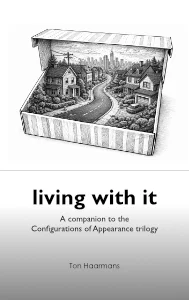
Living with It is a companion to the Configurations of Appearance trilogy. It gathers the central ideas of This Is It, Mindsets and Origins, but presents them in a more direct, personal and practical form. Rather than extending the trilogy with another philosophical system, it asks what it is actually like to live once the search for foundations, final truths and higher standpoints has begun to lose its grip.
The book begins from a simple reversal. Instead of imagining reality as a hierarchy of deeper and shallower levels, it approaches experience as a landscape of configurations. A scientific explanation does not stand above ordinary perception. A spiritual experience does not necessarily penetrate beneath everyday life. A dream is not less real while it is being dreamed. Each is a temporary way in which experience coheres and presents itself as a world.
Not higher and lower, but different.
This flattening does not make all worlds identical or equally workable. It removes only the assumption that one of them must occupy the summit. Differences remain. Some worlds are stable, shared and resistant. Others are fragile, private or short-lived. Some support action; others intensify suffering. But none can step outside experience and establish itself as the final measure of all the others.
The diorama
The central image of the book is the diorama: a small constructed scene that becomes a world when viewed from the right position. Cardboard, paper and glue suddenly produce depth, distance, foreground and background. For a moment, one no longer sees a box. One sees a landscape.
The same may be true of experience. A world does not simply exist as a finished container waiting to be entered. It forms together with the distinctions, expectations, memories and forms of attention through which it is encountered. It already includes a here and a there, what matters and what does not, what is near and what is distant, who seems to be looking and what seems to be looked at.
Stepping out of one diorama never produces a view from nowhere. It only places us in another: the room around the box, the house around the room, the street around the house. Every supposed outside becomes another scene with its own framing and assumptions.
The book itself does not claim exemption. It too is presented as a temporary construction: another small world made of language, inviting the reader to look through it for a while.
No final standpoint
Philosophy, science and religion have repeatedly searched for a neutral position from which reality could finally be described as it truly is. Yet every view requires distinctions, interests and a field of relevance. Something must stand out against something else. Remove every viewpoint and nothing becomes more objective. Nothing remains visible at all.
Whenever an account claims to speak from nowhere, it quietly installs another somewhere and presents it as universal. This does not mean that precision or objectivity are impossible. It means that objectivity is achieved within a world through shared procedures, correction and comparison, not by escaping perspective altogether.
The same applies to the search for a ground. Matter, consciousness, God, natural law, information or mathematical structure may all be proposed as the foundation beneath appearances. But every such foundation appears within the world it is supposed to support. It becomes a theory, concept, model or belief. The search therefore continues indefinitely, each ground requiring another beneath it.
Perhaps worlds do not hold because they rest on bedrock. Perhaps they hold because patterns repeat, relations reinforce one another and coherence persists long enough to feel necessary.
Groundlessness is not chaos. It is the absence of ultimate justification.
How worlds are assembled
The second part of the book turns from orientation to construction. Experience is never raw. Perception filters and predicts. Memory rebuilds rather than retrieves. Language draws distinctions. Emotion changes what stands out. The body organises space according to possible action, need and vulnerability.
We do not first perceive a neutral world and then interpret it. Perception is already interpretation. Seeing a chair means encountering something as sit-on-able. Seeing a face already involves reading expression and intention. A room appears as complete even though sensory input is partial, corrected and filled in.
A configuration is the temporary organisation produced by these processes. It is not a consciously adopted theory, but the background structure that determines what can appear as real, relevant or obvious. The configuration usually remains invisible because it simply feels like the world.
Belief is the point at which interpretation hardens into necessity. Knowledge is belief disciplined through method, testing and shared correction. Consciousness may be less a separate substance than a name for the fact that something appears at all. Distinction allows anything to show up as anything, while rhizomatic connections prevent those distinctions from settling into a single hierarchy or origin.
The self and its sense of agency also belong to this construction. Thoughts arise, movements begin and decisions occur, while the narrative of authorship often appears alongside or afterwards. The “I” may be less a sovereign controller than a useful centre of continuity through which consequences and responsibility can be organised.
Worlds from the inside
The longest part of Living with It enters a series of experiential dioramas. These chapters do not define mindsets from the outside. They describe what each world feels like while it is active.
The conventional world presents itself as simple reality. Objects have stable purposes, time stretches forward through calendars and obligations, and social arrangements feel natural because everyone participates in them. Its great strength is practical continuity. Its invisibility makes it the most convincing diorama of all.
The scientific world reorganises appearances into measurement, mechanism and explanation. A stone becomes mass and molecular structure; light becomes wavelength; the body becomes organs and signals. This orientation has enormous practical power, but may forget that its models remain constructions within experience rather than a view from outside it.
The therapeutic world reads events as expressions of an inner history. Conflict becomes pattern, fatigue becomes symptom, memory becomes key and the self becomes a project of healing and integration. It gives suffering language and attention, but may turn every ordinary feeling into evidence of something beneath it.
The hyper-attuned world is characterised by reduced filtering. Details remain vivid rather than dissolving into background. Sounds, textures, movements and small changes all remain present. This can make experience rich, precise and fascinating, but also saturated and exhausting. The same environment becomes another reality when the resolution of perception changes.
The spiritual world looks for depth, awareness, presence and awakening. Everyday life is reframed as practice, thought becomes identification and silence becomes more fundamental than activity. It can lighten the burden of identity, but also rebuild the hierarchy it hoped to escape by valuing depth over surface and awakening over ordinary life.
The non-dual world removes even that spiritual framing. Nothing is missing, nothing hides behind what appears and no self can be found standing apart from events. Walking happens, thinking happens, irritation happens. This can feel radically simple, but it remains another configuration rather than the final truth about reality.
The early world evokes childhood before experience has hardened into explanations and identity. A stone is this particular stone, a puddle something to enter, a chair a possible ship. Perception and action remain close, time is not yet heavily scheduled and the self has not become an ongoing project.
The virtual world makes construction explicit. A few coordinated visual and auditory cues can generate a convincing space in which the body reacts before philosophy has time to object. The world is known to be artificial and is nevertheless experientially real. Virtual reality reveals that worldhood depends less on metaphysical status than on coherence and responsiveness.
The dreaming world provides an even more familiar demonstration. Every night an entire reality appears without physical construction, maintains itself with little logical consistency and is accepted without doubt until waking. The dream shows how little is required for a world to feel complete from within.
Transitions
We rarely inhabit only one world. The conventional frame may dominate in the morning, the scientific one while solving a technical problem, the therapeutic one during a difficult conversation and the spiritual one during a quiet walk. Sleep replaces the waking world with a dream. A virtual environment forms within seconds. Across years, one orientation may gradually lose its authority and another take its place.
These transitions often have no clear boundary. The centre of gravity simply shifts. What once seemed urgent becomes irrelevant, and what once appeared abstract begins to feel self-evident.
Each configuration claims normality while it holds. Only after it loosens does it become visible as one world among others.
Edges of worldhood
The book also approaches experiences in which familiar structures thin out. These are not treated as deeper realities, but as edges: less organised, not more truthful.
In headlessness, the sense of being positioned behind the eyes disappears. Seeing and hearing continue, but without a felt centre from which they originate. The body remains and action continues; only the organisation around ownership and location loosens.
In emptiness as transparency, objects and thoughts lose some of their apparent density. They no longer point toward a hidden essence or foundation. A sound is simply a sound, a thought simply a thought. Form remains, but without the usual weight and interpretive surplus.
Darkness names something more austere: experience without orientation, promise or clear reference points. It is not mystery, insight or a hidden source. Nothing points anywhere and meaning does not arise. Darkness carries no lesson. It marks the point where organisation fails while appearance continues.
The chapter on death brings the inquiry back to its most personal edge. The book offers no metaphysical reassurance. It admits fear, uncertainty and the likelihood that death resembles the absence of experience under anaesthesia. At the same time, it refuses certainty in either direction. Nobody stands outside death to report what it ultimately is.
What remains certain is more immediate: this body aging, this breath, this moment of life occurring without final explanation.
Living without foundations
The final section asks what practical difference any of this makes. If every world is partial, if no foundation guarantees our choices and if there is no final standpoint, how does one continue to act?
The answer is deliberately modest: we continue, but perhaps with slightly less weight. Less certain that the current configuration is the only possible one. Less inclined to absolutise our preferences. More willing to treat worlds as provisional structures that work for a time and may later require rebuilding.
This is not detachment from life. It is participation without pretending to stand above the scene.
Working worlds
A website, a book, a room, a routine, a friendship or a conversation can all be understood as working worlds: temporary arrangements that create enough coherence for something to happen. Their value does not depend on ultimate truth. They need only function under present conditions.
The maker does not discover their eternal form. He adjusts them. A paragraph is shortened. An image moved. A menu simplified. A chair added. Something that produces friction is removed. Life becomes less like the construction of a monument and more like work in a workshop.
A working world does not need to last forever. It only needs to work now.
This applies equally to writing. A text becomes a small environment rather than a statement from outside experience. Tone, rhythm, images and ideas are arranged until the whole can briefly stand. Nothing is definitive. Nothing needs to be preserved simply because it has already been made.
Ethics without foundations
The disappearance of ultimate principles does not cause ordinary ethics to collapse. People still care, apologise, help, maintain trust and try not to create unnecessary harm. Much of this occurs before anyone formulates a theory.
Ethics in this book is less a matter of obedience to eternal laws than of maintaining a shared world. Some actions produce tension, distrust and escalating difficulty. Others make a situation more workable. Consequences remain real even when no metaphysical system guarantees them.
This is not a heroic morality. It is practical, unfinished and often inconsistent. Avoid unnecessary damage. Repair what can be repaired. Help where doing so is possible. Do not make an already difficult situation harder without reason.
Such an ethic has no cosmic authority. It arises from the simple fact of living with others inside worlds that can be damaged.
Why this is not relativism
To call worlds constructed does not mean that they are interchangeable. Drinking water is not the same as drinking bleach. Walking into a wall has consequences regardless of one’s philosophy. The physical world is dense, resistant and widely shared. Other worlds may be more fragile or dependent on specific conditions.
The absence of foundations removes final justification, not structure. Bodies require food and sleep. Trust can be destroyed. Environments can support or exhaust us. Some arrangements repeatedly fail while others prove workable.
Relativism imagines weightlessness, as though any reality could be chosen arbitrarily. Actual experience is constrained at every turn.
Not everything is equal. Only everything is provisional.
A practice of attention
The book ends not with a method, but with a modest form of attention. Making coffee, letting the dogs out, watching the weather, hearing wind in the trees, moving words on a page. Nothing is elevated into spiritual practice. Nothing needs to reveal a hidden truth.
Attention simply returns experience to its actual scale. The room becomes just the room. A mood becomes today’s weather rather than evidence of a permanent condition. Problems lose some of the additional weight created by imagined futures, comparisons and stories about how life should have been.
This attention is unreliable. It is forgotten, interrupted and repeatedly replaced by distraction. There is no stable state to maintain. Occasionally one simply notices: here we are again.
Living with It does not conclude the trilogy by solving its questions. It brings them back into daily life. Worlds continue to form. Beliefs still harden. Explanations still help. Bodies age. Projects begin and are abandoned. Nothing guarantees that the current arrangement will last.
What remains is the workshop: attention, adjustment and the making of small worlds that hold for a while.
Living with It: A Companion to the Configurations of Appearance Trilogy
Ton Haarmans, 2026
Companion volume to the series Configurations of Appearance.
Download the book on the [[/content/resources/downloads|download page]] of this project or order it from Amazon.
Leave a reflection
If this page prompted a thought, question or observation, you can send it to Wide Open Windows. Nothing is published automatically.