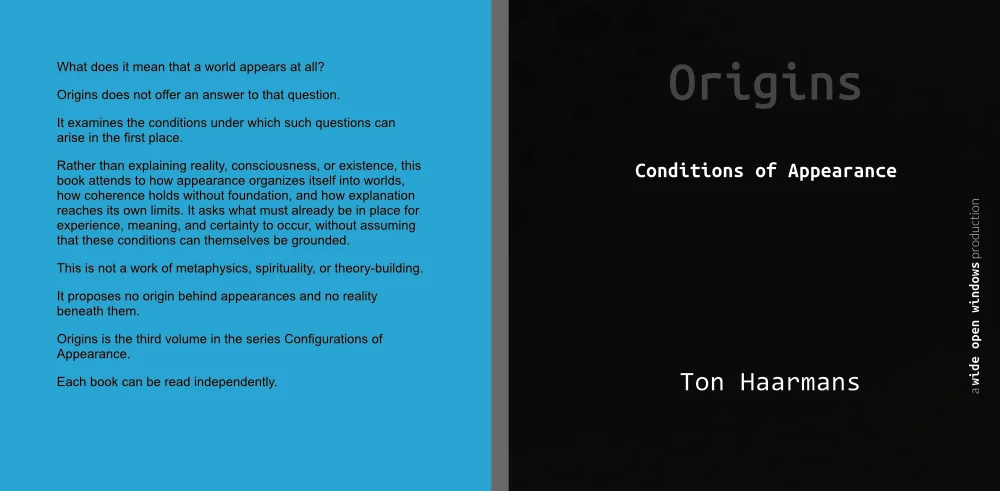
Origins: Conditions of Appearance is the third and concluding volume in the series Configurations of Appearance. Where This Is It examined the immediacy of experience and Mindsets mapped the different configurations through which worlds take shape, Origins steps back further. It asks what must already be the case for anything like a world, an experience or a subject to appear at all.
The title is deliberately misleading if it is understood as a search for a first moment, a cosmic beginning or an underlying substance. This book does not ask where the world came from in time. It asks about origins as conditions: the structural possibilities that allow appearance to stabilise into form, continuity, identity and meaning.
Before there are worlds, there is appearance.
This appearance is not yet a collection of objects, events or relations. It is not a scene observed by a subject, nor a field called consciousness in which things arise. Those descriptions already belong to a world. What is at stake is more fragile: the bare fact that something can show itself at all, before distinctions such as subject and object, existence and non-existence, inside and outside have acquired their familiar force.
Not yet a world
A world is not given all at once. It emerges when appearance begins to hold. Differences repeat. Regularities form. Some patterns persist while others disappear. What stabilises becomes recognisable, and what becomes recognisable makes orientation possible. Only then can there be things, identities, locations, causes and expectations.
Not yet a world therefore does not refer to an incomplete or primitive state waiting to develop. It names appearance before its organisation has hardened into inevitability. It is not a temporal past hidden behind the present, but a structural openness that remains active whenever a world takes form.
A world is a way of holding appearance together. It gathers what shows itself into relatively stable distinctions: this rather than that, here rather than there, self rather than environment. These distinctions are not imposed by an external intelligence. They emerge through repetition, reinforcement and exclusion.
What stabilises begins to feel necessary. What repeats reliably begins to appear as reality itself. Yet this sense of necessity is an effect of continuity, not evidence of an underlying ground.
Without ground
Human thinking repeatedly searches for foundations. Matter is grounded in fields, fields in equations, equations in mathematical structures. Consciousness is grounded in the brain, the brain in biology, biology in chemistry and chemistry in physics. Religious and spiritual traditions replace these with God, awareness, being, emptiness or an unconditioned source.
But every proposed foundation already appears within the world it is supposed to support. It becomes a concept, a model, a principle or an object of thought. Once it appears as something, it can no longer function as a ground outside appearance. It belongs to the field it claims to explain.
This does not mean that nothing holds. Worlds are remarkably stable. Patterns endure, explanations work and meaning persists. What fails is not structure, but final justification.
A world holds not because it rests on something deeper, but because it keeps holding.
Stability can arise through repetition, constraint and mutual reinforcement without requiring an ultimate foundation beneath it. Groundlessness is therefore not a hidden depth or a metaphysical doctrine. It is the quiet recognition that no final support can be brought into view.
This absence of ground does not destroy order. It makes change possible. Because no configuration is secured by necessity, worlds can reorganise, dissolve and give way to others.
Conditions rather than causes
Within an established world, causal explanation is indispensable. Causes allow prediction, intervention and control. They link events within a field in which time, sequence and regularity already have meaning.
But causality cannot explain the conditions under which causal explanation becomes possible. A cause produces an effect within an existing framework. A condition does not produce anything. It allows a framework to arise in which production, sequence and explanation can make sense.
This distinction limits the reach of explanation without denying its value. Scientific models may explain how structures behave, how organisms develop or how patterns persist. They do not explain why there is appearance at all. When causes are stretched beyond their domain, explanation quietly becomes metaphysics.
Origins does not oppose science. It draws a boundary around what scientific explanation can legitimately claim. Physics describes structure, relation and regularity. It does not provide an account of why there is a world in which structures, relations and observers can appear in the first place.
Before experience
Experience is often treated as the most secure starting point. Whatever else may be doubted, there is at least something being experienced. Yet the book argues that experience itself is already an organised outcome.
For experience to occur, appearance must have acquired a minimum of stability, differentiation and continuity. Something must persist long enough to register. This must be distinguishable from that. One moment must relate to another. Without these conditions, there is no experience of anything, only appearance that has not yet become intelligible as an event or object.
The subject does not precede this organisation. There is no pure experiencer waiting to receive impressions. Subject and experience emerge together within a world that has already begun to distinguish here from there, mine from not-mine and now from then.
Experience therefore cannot serve as an ultimate foundation. It is immediate only because its own conditions remain hidden.
The emergence of pattern
A world begins neither with objects nor with meaning, but with difference. Something varies. Something repeats. Something becomes distinguishable from what does not.
Pattern arises when difference begins to hold. Recurrence becomes recognisable, and what repeats starts to shape what can appear next. No one designs this pattern. No principle governs it from above. Certain variations simply reinforce themselves under the conditions in which they occur.
Many differences never stabilise. They appear and disappear without becoming part of a world. Others persist and gradually acquire the authority of the obvious. What repeats reliably no longer seems contingent. It begins to look like necessity, law or nature.
Patterns do not explain worlds. They make worlds possible.
A world is a field in which some patterns have become dominant enough to organise perception, expectation and response. These patterns remain vulnerable. When their supporting conditions change, the world may loosen, reorganise or collapse.
Worlding
The word worlding shifts attention from the world as a thing to the continual maintenance through which a world appears stable. A world is not a container in which experience happens. It is the coherence produced when patterns, distinctions and expectations reinforce one another.
Worlding is not an activity performed by a subject or system. It names the fact that certain habits of appearance recur, align and exclude alternatives. When this succeeds, its ongoing work disappears from view and the world feels simply given.
But every world also produces limits. Not everything can be integrated into its dominant patterns. Some differences remain marginal, unintelligible or invisible. A world is constituted as much by what cannot appear within it as by what it includes.
Different forms of worlding therefore produce different realities of relevance. What counts as real, meaningful, obvious or impossible depends on the patterns through which coherence is sustained.
The limits of appearance
Not everything can appear. This does not mean that hidden objects exist behind experience waiting to be discovered. The limit is more fundamental. For anything to appear, it must enter into a field of distinction, repetition and relation. It must be able to register as something.
What cannot enter such a field does not appear as absent. It does not appear at all.
These limits cannot be crossed by better instruments, wider awareness or more refined perception, because every such attempt already relies on the conditions whose limits are in question. Appearance has an internal edge. Beyond that edge there is no concealed content that could later be made visible.
This is not a deficiency of human knowledge. It is constitutive of appearance itself. Without limits, nothing could appear as anything.
The silence of explanation
Explanation stabilises worlds. It places events within causal chains, mechanisms and reasons. It gives uncertainty a form and often brings genuine practical clarity.
But explanation eventually reaches a point at which it no longer gains purchase. It can describe more detail, propose deeper layers and introduce new models, yet it cannot explain the possibility of explanation itself.
At this edge, silence appears. Not mystical silence, not ineffable wisdom and not a higher form of knowing. It is simply the absence of further explanatory reach.
Nothing is revealed behind the failure of explanation. No secret ground remains waiting beneath language. The silence marks only that explanation has left its proper domain.
This silence offers no consolation. It does not complete understanding. It exposes the fact that explanation was never foundational, however powerful it may be within a world.
No view from nowhere
The dream of objectivity often takes the form of a view from nowhere: an account free from perspective, orientation and interest. From such a position, appearances could supposedly be corrected against reality as it truly is.
But every view emerges within conditions that determine what can count as relevant, visible and intelligible. Subtracting perspective does not leave pure vision. It removes the very structure that makes seeing possible.
This does not mean that all accounts are equal. Some are more coherent, more precise or more effective. Yet none escapes the world in which its criteria of validity have meaning. Even mathematics, logic and the most abstract physical theories remain articulated within a field of appearance.
The book does not exempt itself from this limit. It does not claim to describe the conditions of worlds from outside them. It is itself another situated articulation, shaped by language, history, tools and the very structures it examines.
After worlds
The final movement of the book turns toward what remains when the authority of worlding loosens. This is not a final state, a spiritual achievement or a return to origin. Worlds continue to appear. Meaning, explanation and orientation repeatedly reassert themselves.
What fades is only the demand that appearance must resolve into a final and coherent whole.
After worlds, there is no hidden reality revealed beneath familiar structures. There is no pure awareness, darkness, emptiness or unconditioned field waiting to be uncovered. Appearance no longer needs to function as evidence of something beyond itself. It simply appears.
This loosening is temporary and carries no instruction. It does not prescribe silence, openness or detachment. Any prescription would already establish another world with its own values and direction.
After worlds, nothing needs to follow.
Origins completes the series by refusing the final move that philosophical and spiritual systems repeatedly make: turning the conditions of appearance into a new foundation. It traces how worlds become possible while leaving their possibility unclaimed.
The result is not a theory of reality, but a careful encounter with the limits of theorising. Appearance continues without ground, explanation or guarantee. Worlds arise, stabilise and dissolve. No origin is finally uncovered, because every origin that can be named has already become part of a world.
Origins: Conditions of Appearance
Ton Haarmans, 2025
Third volume in the series Configurations of Appearance.
Download a chapter on the [[/content/resources/downloads|download page]] of this project or order the book from Amazon.
Leave a reflection
If this page prompted a thought, question or observation, you can send it to Wide Open Windows. Nothing is published automatically.