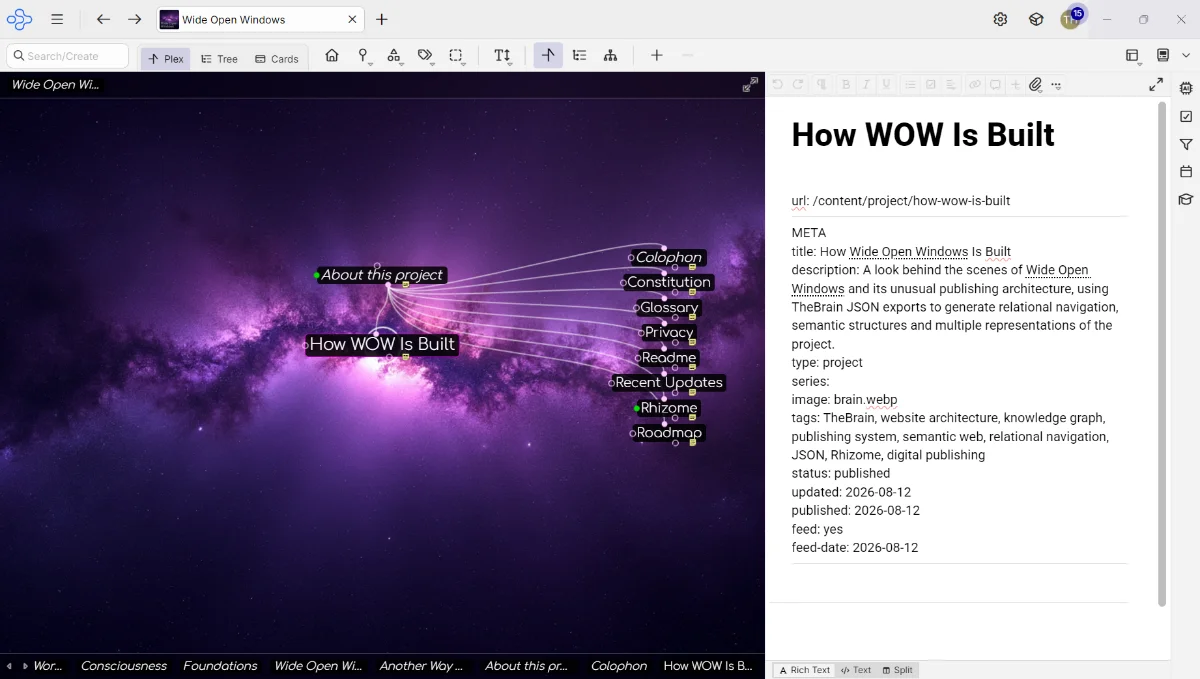
Wide Open Windows is not built around a conventional content management system. Its underlying structure begins somewhere else: in TheBrain.
TheBrain is where the project is organised, where relationships between subjects are made, and where new connections gradually emerge. The public website is, in a sense, a projection of that evolving structure, which makes the technical architecture of Wide Open Windows rather different from that of a normal website.
TheBrain also resonates with a central idea in the philosophy of Wide Open Windows: a non-hierarchical view of experience, in which perspectives exist alongside one another rather than being ordered from lower to higher.
TheBrain as the structural source
At the centre of the system is a Brain containing thoughts such as Lived Experience, Phenomenology, Predictive Processing, Non-duality, Dreams, Awakening, Anaesthesia and individual essays, observations and project pages. These thoughts are connected through TheBrain's parent, child and jump relations.
The important point is that these relations are not merely notes for myself. They eventually become part of the navigation and semantic structure of the public website. There is therefore no separately maintained website tree that has to be kept synchronized with the Brain: the Brain is the starting point.
From Brain to website
TheBrain can export its structure as JSON. Wide Open Windows uses that exported data as raw material for a small publishing system written mainly in PHP.
In simplified form, the process looks like this:
TheBrain → JSON export → WOW builders → website
The export contains the thoughts and their relations. WOW's own scripts then interpret this information and build several derived structures used by the site.
Among other things, the system determines:
- which thoughts correspond to public pages;
- how pages are related to each other;
- which thoughts are parents, children or lateral connections;
- how the Rhizome navigation should behave;
- which pages belong to particular sections or types;
- and how this structure can also be exposed as machine-readable data.
The result is not a static export of a Brain. The Brain provides the relational skeleton; the website adds publication logic, page content, presentation and additional metadata.
Content and structure remain separate
The actual texts are stored as content files on the website. A page contains its own metadata — title, description, type, image, publication information and other properties — together with its HTML content. The Brain therefore does not have to contain the complete publication. Its main task is different: it describes how the parts of the project belong together.
This separation turned out to be important. I can reorganise relationships in TheBrain without rewriting the articles themselves, while texts can evolve without losing their position in the larger network.
The Rhizome
The most visible result of this architecture is the site's Rhizome. Instead of presenting visitors with only a conventional hierarchical menu, every page can show its immediate surroundings in the network.
TheBrain's Parents, Children and Jumps are translated on the website as Part of, Opens to and Related. In addition, the siblings of the current page — or current Window — are presented as Alongside.
A visitor reading an essay about awakening, for example, may discover not only the section it belongs to but also lateral connections to non-duality, perception, experience or another essay. Navigation therefore becomes exploratory rather than merely hierarchical, and that is deliberate.
Wide Open Windows investigates how worlds and perspectives emerge through relations. It seemed strange to describe such a project with a rigid tree structure. The Brain offered a way of allowing the architecture of the website to become relational as well.
Several representations of the same project
Once the Brain structure has been translated into structured data, it can be used for more than navigation. Wide Open Windows currently generates or maintains several representations of the project, including:
- the human-readable website;
- the Rhizome navigation;
- a search index;
- automatically generated sitemaps;
- RSS;
- Schema.org / JSON-LD metadata;
- a semantic WOW JSON representation;
- and a read-only public API.
These are not separate databases. As far as possible, they are different views of the same underlying structure. This has gradually become one of the central technical principles of the project: maintain the meaning and relationships once, then derive multiple representations from them.
A small publishing system rather than a CMS
Technically, Wide Open Windows is deliberately modest. The public site is primarily PHP, HTML, CSS and JavaScript. There is no WordPress installation, no large framework and no conventional CMS database behind it. Instead, a collection of small builders and update scripts performs the tasks normally handled by a CMS.
The workflow is roughly:
- Think, connect and reorganise material in TheBrain.
- Export the Brain structure.
- Run the WOW update/build process.
- Add or revise the actual page content.
- Generate the derived navigation, search and semantic structures.
- Publish the result.
The system has grown incrementally. Most of it exists because at some point I encountered a concrete problem and wrote the smallest mechanism I could devise to solve it.
TheBrain as a publishing instrument
I did not initially set out to turn TheBrain into part of a publishing system. I had used it to think, organise material and discover relationships, but gradually an interesting possibility became apparent: if the relationships in the Brain already express how I understand the project, why recreate those relationships manually in a website?
That question eventually changed the architecture of Wide Open Windows. TheBrain is still my private thinking environment and the website is still a public publication; they are not the same thing. But the JSON export creates a bridge between them, allowing a private conceptual network to become the structural basis of a public digital environment.
An evolving experiment
The system is still developing, just as Wide Open Windows itself continues to develop. The project is an investigation into experience, perspectives and the emergence of lived worlds, and its technical architecture has increasingly become part of that experiment rather than merely the machinery used to publish it.
There is no single privileged route through the material. There are neighbourhoods, paths, crossings and unexpected connections, and the architecture allows visitors to move through them without requiring everything to be fitted into one definitive hierarchy. In that sense, the technology has gradually come to reflect something fundamental about the project itself: it does not merely contain the idea of a relational world, but increasingly enacts it.
Leave a reflection
If this page prompted a thought, question or observation, you can send it to Wide Open Windows. Nothing is published automatically.