
Several people I know are passionately concerned with the political and social world. They follow what governments do, worry about inequality, capitalism, war, climate, the rise of the right, and have strong opinions about what is happening and what should happen instead. Sometimes I find their involvement touching, because I recognise it very well. At other times I find it a little naïve, or rather rigid and predictable. This is not necessarily a very generous reaction, but it interests me because there was a time when I was every bit as involved as they are.
Politics once mattered enormously to me. I was involved in anarchism, men's liberation and socialism, went to demonstrations, took part in actions and spent countless hours discussing what was wrong with society and how it might be changed. I still have photographs from those years: demonstrations in wet Dutch streets, black flags, squatted houses, long-haired friends sitting around tables. Looking at those photographs now is peculiar, because nothing in them announces itself as a worldview. We were not people who had adopted a particular interpretation of reality and were now acting accordingly. We were simply living our lives, concerned with things that quite obviously mattered.
For a long time, however, that was not the only world I inhabited. I had already been reading books about subjects that would broadly be called spiritual. Castaneda fascinated me, as did Gurdjieff and Krishnamurti. I had also tasted co-counselling and radical therapy and was interested in exploring the personal, in discovering what made us who we were and whether something could fundamentally change in us. There had probably always been something in me that wanted to get underneath things, to discover something universal rather than merely another opinion about how society or a human life ought to be organised.
Strangely enough, none of this initially interfered very much with my political life. I could demonstrate, take part in actions and discuss anarchism and socialism, and then go home and read Castaneda. Apparently I had room for both. The political and the spiritual belonged to different parts of my life, and I felt no great need to make them consistent with each other.
That changed when I encountered Bhagwan, as Osho was called at the time. I read his books voraciously, and again and again he made me reconsider things I had taken for granted. He would turn something around, attack an assumption I had hardly realised I possessed, or make something I had considered important suddenly seem beside the point. The man made me think, and I repeatedly found myself having to admit that he had a point. Gradually it became impossible to keep my political and spiritual worlds comfortably apart.
It was no longer enough to be interested in spiritual ideas while continuing the rest of my life as before. If there really was something to discover about myself, about consciousness, perhaps even about enlightenment, then I wanted to find out. I wanted to live it, not merely read about it, and I wanted to go all the way. The political world that had occupied so much of my life began to seem not so much wrong as strangely unimportant, and I wanted to leave it behind.
I had a glass container in my room into which I put symbols of convictions that had become obsolete. I no longer remember exactly what I put in it, although there were probably some political buttons among them. At the same time, I was writing my new insights in large felt-tip letters on the walls of my living unit. In retrospect I rather like the combination: the old convictions went into the glass container while the new ones appeared on the wall. Of course, I did not experience it that way. What went into the container were convictions; what appeared on the wall were insights.
Politics and activism began to seem almost embarrassingly superficial. Changing society was all very well, but what was the point if the people creating that society remained unconscious, conditioned, frightened, aggressive and ambitious? Finding the truth about myself, exploring consciousness and perhaps becoming enlightened seemed incomparably more important. Some of my former fellow activists began to look like Neanderthals to me. I was quite capable of arrogance, and apparently that particular trait did not find its way into the glass container.
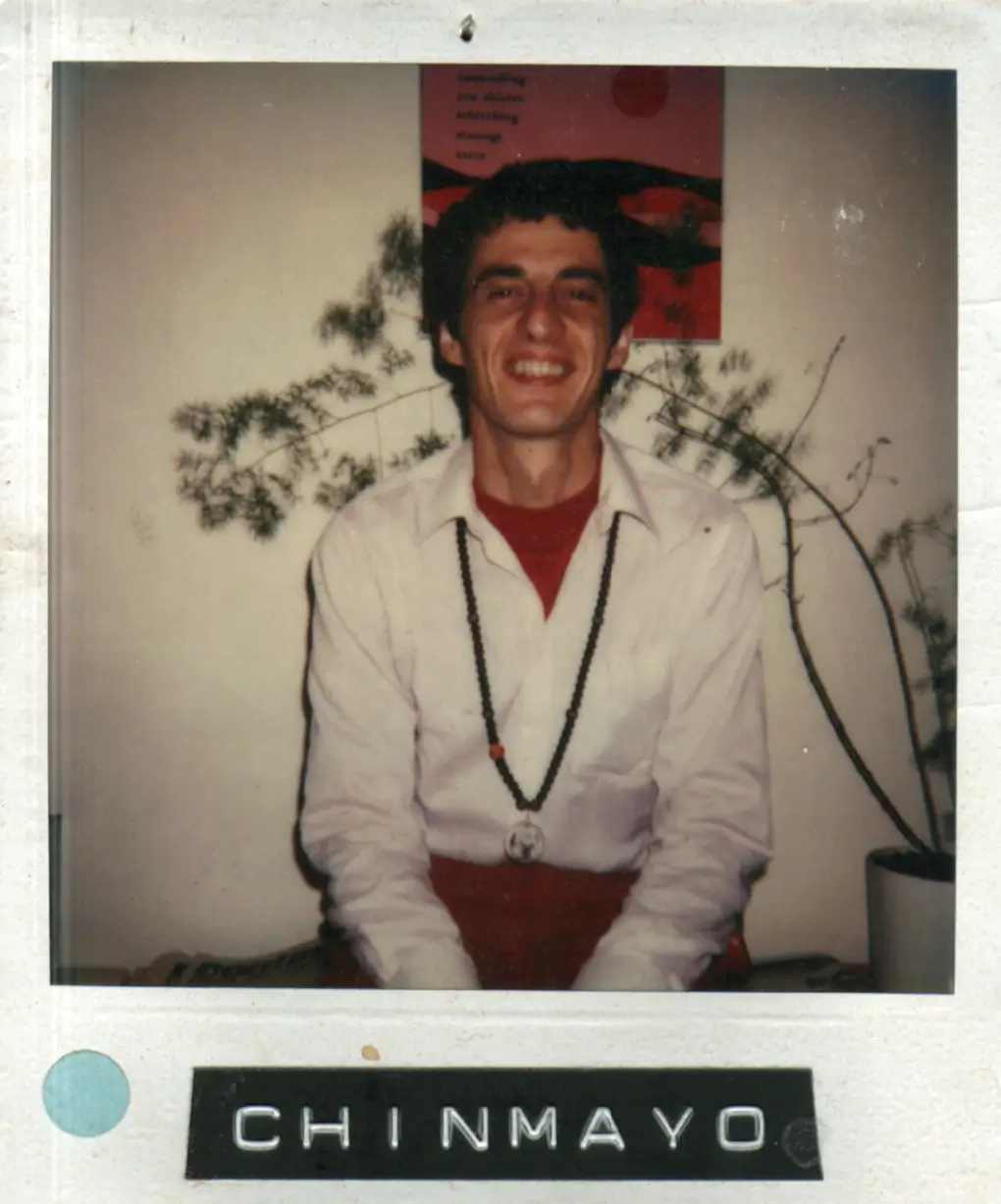
Eventually I became a sannyasin and was given the name Swami Pantha Chinmayo, which I understood as something like the path to consciousness. I never much liked Pantha; it didn't sound cool. Chinmayo was much better, and eventually it became simply Chin. Whatever I thought of the sound of the name, its meaning fitted rather well. There was a path and I was on it, although neither the path nor its imagined destination would remain the same.
Not everything I encountered during those years belonged neatly to one stage or another. Douglas Harding, for instance, somehow remained convincing to me through very different periods. His way of looking had already felt right during my sannyas years, and it continued to feel right later, through satsang and beyond. It did not seem to compete with the other teachings so much as slip through them. Only much later did I begin to see even that as another possible configuration of experience rather than as a privileged description of how things ultimately are.
UG Krishnamurti occupied a very different place. He seemed less interested in offering a world than in undermining whatever world happened to be available. He kept poking holes in spiritual claims, disturbing settled ideas and refusing to let the whole enterprise become too comfortable. I liked that. There was something useful in having someone around, intellectually speaking, whose role was not to provide the next answer but to keep setting fire to the answers already on the table.
When Osho died, the spiritual world around him changed. Many sannyasins began to visit satsangs with Advaita teachers, and I moved in that direction too. Poonjaji became an important name, as did Nisargadatta, and there were increasingly Western teachers who presented the same basic message in a setting that felt much closer to home. That accessibility was part of the attraction. These were not necessarily remote gurus surrounded by an exotic spiritual world. You could sit in a small room, ask questions and, with some of the Western teachers, have a beer afterwards. I liked that.

Barry Long briefly caught my attention as well, although that did not last very long. Something about him quickly put me off (he called himself 'Master of the West'). Advaita itself was different. It felt extraordinarily convincing, and in some ways it seemed to take the spiritual search I had already been engaged in and push it to its logical extreme.
Perhaps there was no separate person who had to become enlightened in the first place. Perhaps the seeker itself was part of the misunderstanding. What I really was, according to increasingly familiar formulations, was not the changing person with his history, thoughts and problems but Awareness itself, the open knowing in which thoughts, sensations, perceptions and the world appeared and disappeared. Later, in Western non-dual and Awareness teachings, this could be expressed with great clarity and apparent simplicity.
I spent a long time with teachings of this kind and took them seriously. There was something wonderfully slippery about them. I was still looking for something, but was now being told that there was nothing to find; I wanted to get somewhere, but apparently there was nowhere to go; I wanted to awaken, while the person who wanted to awaken was itself said to be an illusion. None of this stopped the search. If anything, it gave it an almost inexhaustible subtlety.
There were books and talks, teachers and conversations, insights that seemed important and questions that could always be made a little finer. Had I really understood? Was there still some subtle identification going on? Was Awareness something I experienced, or was it what I actually was? And if there was no seeker, who exactly was worrying about whether the seeking had ended? A teaching in which there was ultimately nothing to attain could, paradoxically, provide an enormous amount to occupy oneself with.
For a long time the search survived every change in what I thought I was searching for. Looking back, that continuity seems more striking to me than the differences between the teachings. Osho, Harding, satsang, Advaita and later Western Awareness teachings were not the same thing, and I did not experience them as one coherent system, but they could all coexist with the sense that something fundamental might be discovered, recognised or seen through. There was still a special kind of truth at stake, one that seemed to matter more deeply than ordinary knowledge.
What began to disturb that continuity was not a final spiritual insight but encounters with people who questioned the whole enterprise in ways I could no longer easily dismiss. The work of Robert Saltzman, and later my contact with Shiv Sengupta, gradually undermined my confidence in spiritual teachings themselves: the claims made for awakening, the authority given to teachers, the special status of certain experiences, and the assumption that somewhere behind all the different teachings there was a spiritual truth towards which they were pointing.
In a sense, Saltzman took over something of the role UG Krishnamurti had long played for me. He kept undermining, questioning, disturbing, refusing to let spiritual language protect itself by becoming vague enough to escape criticism. What appealed to me was precisely that he did not seem interested in building another spiritual system on top of the ones he attacked.
Miranda Warren affected me in a somewhat different way. What began to fall apart there was not the possibility or value of non-dual experience itself, but the elevation of non-duality into an absolute description of reality. I could no longer see why an experience in which the usual separation between self and world disappears should automatically reveal what Reality ultimately is. It may be profound, liberating or life-changing, but that does not necessarily turn it into a privileged view from nowhere.
This also changed the way I looked back at Harding. His vision had remained persuasive to me through so many different phases that I had hardly thought of it as belonging to one particular spiritual world. It seemed more basic than that. Now I can see it differently. I do not have to dismiss the experience he points to, or deny that it can feel immediate and obvious. But I no longer need to treat that obviousness as evidence that a final truth about reality has been uncovered. It can also be understood as a configuration one can enter, inhabit and find completely convincing.
That is a much less dramatic change than throwing political buttons into a glass container. Nothing had to be rejected with a flourish. I did not suddenly decide that Harding was wrong, that Advaita was nonsense or that all spiritual experience was merely illusion. What changed was the status I gave these things. They no longer seemed entitled to stand above other ways of experiencing and describing reality.
This was quite different from what had happened when I discovered Bhagwan. Then one world had become so compelling that I wanted to leave another behind and throw myself completely into the new one. Saltzman, Sengupta and Warren did not offer me another spiritual world to move into. There was no new teaching to write on the wall. If anything, their influence made it increasingly difficult for me to believe that I needed such a teaching at all.
What eventually happened to the search itself is harder for me to describe, because there was no dramatic breakthrough and, as far as I can remember, no moment when I decided I had had enough. I did not discover that all spiritual teachings were false, solve the problem of consciousness or finally succeed in becoming enlightened. I simply became less and less interested in the whole enterprise. Questions that had occupied me for years gradually ceased to demand answers, and eventually I noticed that I no longer particularly wanted what I had spent so long trying to find.
I still find that remarkable. I know what people mean when they talk about awakening, enlightenment, Awareness or the separate self, and I can still follow the arguments perfectly well. I may even agree with some of them. But agreement is no longer the point. Something that once had enormous gravity for me no longer has it.
This is perhaps why I have such mixed reactions when I encounter people who still seem completely at home in one of these worlds. On Facebook I sometimes come across devoted followers of Osho who post photographs of him, quote him and repeat things he said with apparently the same excitement I once felt. I understand the words and I know the world from which they come, yet I no longer understand how it can still be so important. I have to admit that sometimes I even find it a little sad.
Something similar can happen when I encounter people who are intensely occupied with awakening, non-duality or Awareness, and, in a rather different way, when friends speak with great certainty about the political and social problems of the world and what must be done about them. My reactions are not always admirable. I can find myself wondering how someone can still be so absorbed in all this, and then remember that I have not only been there myself but have had precisely this reaction before. When the spiritual world took over my life, I looked back at my political friends and wondered how they could still be preoccupied with such superficial matters.
The strange thing is that I do not remember these transitions primarily as changes of opinion. I did change opinions, of course, and particular people clearly played important roles in changing my mind, but something more comprehensive happened. For years I could apparently keep anarchism and Castaneda, political action and spiritual exploration, in different compartments of my life. Then that arrangement became impossible and one world acquired such importance that I wanted to abandon the other for it. After Osho, the spiritual world did not disappear but changed shape and continued through satsang, Advaita and non-duality. Harding somehow travelled through several of those worlds with me. UG kept disturbing them from the side. Much later, Saltzman, Sengupta and Warren loosened the claims that had held the whole spiritual project together, until eventually the search itself no longer exerted the same pull.
Seen like this, my history no longer looks like a neat row of worlds, each replacing the one before it. Some existed alongside each other for years. Some displaced others. Some changed shape without really disappearing. Some ideas survived several completely different phases, and some people seemed mainly to make sure that no phase became too comfortable. The picture is much messier than the tidy story I might once have told about my own development.
That is what feels so strange when I look at the old photographs. I recognise everything: the political world, the interest in therapy and personal transformation, the sannyasin with his mala and his new name, and later the man sitting in satsangs, reading books and thinking about Awareness, awakening and non-duality. I do not look at any of them and think that they were foolish. They were me, and what mattered to them really did matter to me. What I find difficult to recover is the obviousness of it.
Perhaps that is also what unsettles me when I meet someone who is still passionately engaged with something I left behind. I recognise the territory without feeling its gravity anymore. An argument that can occupy someone for hours may seem to me like an argument taking place in a country I once lived in. I remember the language and many of the customs, but I no longer quite understand why this particular border dispute matters so much.
There is an obvious temptation here to turn my own history into a story of development. First I was politically engaged, then I discovered the personal and spiritual, then I moved through Osho, Harding, satsang and non-duality, then certain people helped me see the limitations of spiritual teachings, and eventually I left seeking itself behind. Written like that, it almost inevitably becomes a story of ascent, with the person writing these words conveniently occupying the most advanced position.
I don't experience it that way. For one thing, I remember too well how often an earlier change felt exactly like an advance towards something more fundamental. When I discovered Bhagwan, I was not thinking that I had entered another temporary world. I thought I was leaving superficiality behind. Advaita later felt extraordinarily convincing precisely because it seemed to go deeper still, all the way to the supposed illusion of the person who had been searching. Harding could feel more basic still because his invitation seemed so immediate and difficult to argue with. It would be rather convenient if, after all that, my present way of looking at things happened to be the one position that was no longer subject to the same possibility.
Nor have I become someone without strong interests or convictions. I still spend a great deal of time thinking and writing about experience, reality and the ways worlds emerge. Some ideas excite me and others make me wonder how anyone can take them seriously. I am clearly not standing outside the whole business, serenely watching other people inhabit their little realities. I am still busy with my own.
What remains puzzling is much simpler than any conclusion I could draw from it. I do not understand how something can be important enough for me to organise years of my life around it and later become almost uninteresting. I do not understand how I could write insights on my walls because they seemed so obviously true and now be unable to remember what most of them were. Nor do I quite understand how enlightenment could be important enough to sustain decades of searching and then cease to be something I particularly wanted, without being replaced by some triumphant discovery that finally settled the matter.
Perhaps there is nothing to settle. Even that sentence sounds a little too much like something I might once have written on the wall.
I do wish I still had that glass container, though. I would like to see what I put in it. I suspect there were quite a few buttons. Perhaps I should find another one and put it on my desk, just in case.
Leave a reflection
If this page prompted a thought, question or observation, you can send it to Wide Open Windows. Nothing is published automatically.