We have a persistent habit of imagining that behind the world as we encounter it there must be another world. Not another world in a mystical sense, but the world as it really is: the world freed from the limitations of our particular position within it.
We know, of course, that we see things from particular perspectives. Our bodies, histories, languages and expectations shape what appears to us, and another person may encounter what seems to be the same situation quite differently. Yet somewhere behind this recognition we tend to preserve the idea that all these perspectives are perspectives on something that has its own final and determinate character. If every limitation could somehow be removed, if all information could be gathered and every possible viewpoint combined, surely there would be one complete account of how things really are.
There must, we feel, ultimately be a view from nowhere.
Curiously, one of the places where this assumption has become difficult to maintain is physics itself.
A strange proposal from quantum physics
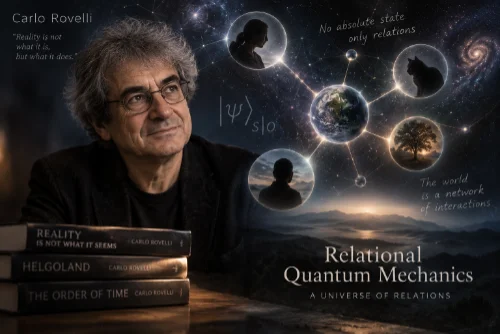
In 1994, the physicist Carlo Rovelli proposed an interpretation of quantum mechanics called Relational Quantum Mechanics, or RQM. Its central idea sounds deceptively simple: the state of a physical system is not an absolute property belonging to that system by itself. A state is always a state relative to another physical system.
Suppose a system S interacts with another system O. After that interaction, a particular property of S may be definite relative to O. Another system, O′, which has not participated in the interaction, may legitimately describe S and O differently. From its perspective, what has already become definite for O may still require a quantum description involving several possibilities.
Our immediate instinct is to ask which description is the correct one. What, after all, is the actual state of S?
But that question contains precisely the assumption that RQM challenges. We are asking for the state of S while removing the relation in which such a state becomes definite. We want to know what S is in itself, independently of any physical interaction, as though somewhere there ought to be a description belonging to reality itself.
RQM denies that quantum mechanics requires such a description. Different accounts can be valid relative to different physical systems without there being another, privileged account standing behind them.
The word observer can be misleading here, because it suggests a human being staring at an experiment, or perhaps even a conscious mind somehow causing an uncertain reality to become definite. Rovelli means nothing of the kind. An observer can be an atom, an electron, a measuring apparatus, a rock or a human body. What matters is not consciousness but interaction. When physical systems interact, they become correlated and information about one becomes available relative to the other.
Reality, in this sense, is relational before anyone thinks about it.
What happened to collapse?
One of the famous puzzles of quantum mechanics is the measurement problem. Quantum theory allows a system to be described as a superposition of possible outcomes, yet when we measure it we encounter a definite result. This has traditionally been described as the "collapse" of the wavefunction, but that immediately raises uncomfortable questions. When exactly does the collapse occur? What qualifies as a measurement? Does it require a laboratory instrument, a living organism, a nervous system, consciousness?
Relational Quantum Mechanics approaches the problem differently. Instead of imagining a universal moment at which one possibility becomes the state of reality for everybody, it treats measurement as an ordinary physical interaction. Relative to the system that has interacted with another system, an outcome has become definite. Relative to a third system that has not yet interacted with them, another quantum description may remain appropriate.
There is therefore no need to imagine a cosmic register in which the one true state of everything is continuously being recorded. Nor is there a need for a cosmic observer reading that register. What exists are systems interacting with systems, and facts that become definite within those relations.
This becomes especially intriguing when we try to speak about the universe as a whole. What would the state of the universe mean? A state relative to what? There can be no observer outside the universe, because anything capable of interacting with it would already belong to it. From a relational perspective, asking for the absolute state of the entire universe may therefore be asking for something that has no physical meaning.
The universe has no balcony from which it can inspect itself. It has no God's-eye camera and no window of its own. What it has are interactions within interactions: physical systems encountering other physical systems, becoming correlated, separating and interacting again. Reality begins to look less like an enormous container filled with things that possess properties and more like an immense network of events and relations.
At this point the physicist's problem begins to sound strangely familiar.
Worlds within worlds
The dioramic approach begins somewhere entirely different. It does not begin with electrons, wavefunctions or quantum measurements, but with lived experience. Yet here too the idea of a world that is simply given, complete and independent of any relation becomes difficult to sustain.
We do not merely receive a finished world. A world emerges through the interplay of body, perception, memory, language, expectation, culture, other people, physical surroundings and countless previous encounters. Together these configure what becomes obvious or strange, relevant or insignificant, threatening or attractive, possible or impossible. They do not merely colour a neutral reality that has already been assembled beforehand; they participate in the emergence of the world in which we actually find ourselves.
I have called such configurations dioramas.
The metaphor has an obvious limitation. A museum diorama has an outside. We can walk around it, inspect the lights, find the painted backdrop and discover how the illusion was constructed. A lived diorama offers us no equivalent position. We can certainly leave configurations behind. Beliefs that once seemed self-evident can become incomprehensible to us. Encounters with another culture can reveal assumptions we did not know we had. Political, intellectual, personal or spiritual transformations can reorganize experience so thoroughly that we seem to inhabit another world.
But when we step outside one configuration, we do not step outside configuration itself. We find ourselves within another.
There is no final balcony here either.
The temptation of the higher position
This is where the resemblance to Relational Quantum Mechanics becomes particularly suggestive. Suppose O describes a quantum system one way while O′ describes it another way. Our instinct is to introduce another observer, O″, who can look at O, O′ and the original system together and tell us what is really happening. But O″ is itself a physical system and therefore enters into its own relations with the others. We have not escaped relationality; we have merely enlarged the relational situation.
Something similar happens when we compare human worlds. We discover that two people, two cultures or two historical periods organize experience in radically different ways, and we naturally try to find a larger framework within which those differences can be understood. There is nothing wrong with doing so. Indeed, it is one of our most powerful ways of learning. A broader configuration can reveal limitations that were invisible from within a narrower one.
The mistake occurs only when we quietly transform that broader configuration into an absolute one.
We imagine that because we can now see the limitations of the previous world, we ourselves have finally escaped limitation. We have climbed one level higher, and from there it is tempting to believe that we can see not merely another configuration but reality as such.
Yet we have stepped outside one diorama only to enter another.
This is what I mean when I say that there is no hierarchy of worlds. It does not mean that every claim is equally accurate, that evidence is irrelevant, or that one way of living cannot be wiser, more generous or more adequate than another. Worlds can be compared. Descriptions can fail. Predictions can be wrong. A configuration can conceal relations that another makes visible. It can sustain suffering, confusion or illusion. There are good reasons to prefer some descriptions, practices and ways of living to others.
But preference, comparison and correction always take place somewhere. They require criteria, and those criteria themselves belong to a world in which certain differences matter. What disappears is not the possibility of judgement, but the fantasy of a final tribunal standing outside every possible configuration.
This is perhaps where Relational Quantum Mechanics and the dioramic approach come closest without becoming the same thing. RQM is a physical interpretation of quantum theory. The dioramic approach is an inquiry into lived worlds. One should not be used as proof of the other. Yet both disturb the same deeply rooted intuition: that behind all situated descriptions there must ultimately be one description that belongs to reality itself.
Perhaps there is no such window.
There are only windows opening from within relations, each making a world visible from somewhere. We can move between them. We can compare what they reveal. We can discover that a window we once trusted concealed more than it showed. We can widen our view.
But widening a view is not the same as escaping all views.
The universe has no window of its own.
Leave a reflection
If this page prompted a thought, question or observation, you can send it to Wide Open Windows. Nothing is published automatically.