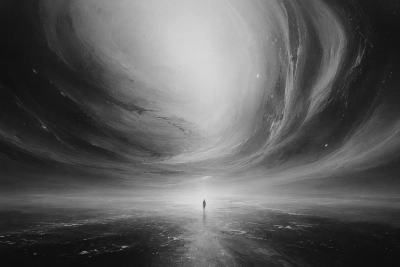
There are moments in which something shifts so subtly that it is almost impossible to say when it began. Nothing in the outer world has necessarily changed. The room is still the same, the light falls as it always did, familiar objects remain where they were, and yet the ordinary structure through which experience usually organizes itself begins to loosen.
It may begin while looking at the night sky, while reading about the early universe, about galaxies moving away from one another across unimaginable distances, about the improbable emergence of life from matter that, for billions of years, knew nothing of itself. Or it may arise without any obvious cause, in the middle of an ordinary day, while standing in a kitchen, walking through a quiet street, or simply sitting still long enough for thought to stop rushing toward its next destination.
What appears in such moments is not merely an interest in the universe, nor simply intellectual curiosity about cosmology, evolution, or consciousness. Something more immediate begins to make itself felt. Beneath the questions about stars, life, or time, another question starts to emerge, often without words: how is any of this appearing at all?
The vast
What presents itself is not only the universe as an object of contemplation, but experience itself. The fact that there is seeing, hearing, memory, sensation, thought, longing, fear, beauty, confusion, and silence. The fact that something is happening, and that it is happening from within experience, rather than being observed from some position outside it.
What often arises here is awe, although awe may not be the best word. It carries associations of admiration, wonder, even inspiration, but what unfolds can be stranger than that. There may be beauty, certainly, but also disorientation. There may be fascination, but also a quiet destabilization, as if the ordinary coordinates through which life usually makes sense begin to lose their obviousness.
From a dioramic perspective, this is not simply an emotional response to something large, nor is it necessarily evidence of spiritual insight or metaphysical revelation. What becomes visible is something structurally more interesting: the configuration of experience itself is beginning to shift.
The familiar human scale, normally built around identity, memory, language, purpose, and social orientation, becomes less absolute. The self does not disappear, but it may no longer feel as central as it did a moment before. Language continues, but it no longer seems fully capable of containing what is being sensed. Knowledge remains available, but its usual certainty softens into something more open, more provisional.
And it is precisely there that awe may arise. Not simply in the stars, not merely in the theories, not even in the universe itself, but in the sudden recognition that the world we usually inhabit, the world that feels so stable, coherent, and self-evident, may be only one possible organization of experience among many.
For a moment, experience does not merely encounter the vast. It encounters the instability of its own boundaries.
The thought of disappearance
If the contemplation of the universe can open a sense of awe, there is another movement that can open something even more difficult to contain. At first it may arise quietly, almost as an afterthought, somewhere in the background of that same wonder. While contemplating galaxies, the emergence of life, or the strange fact that matter has somehow become capable of awareness, another realization begins to form, one that can bring thought to a sudden standstill.
The realization that one day this body will die, and with it, perhaps, everything that is now being experienced.
Not simply memory, identity, relationships, or personal history, but the entire field in which anything appears at all. The seeing of light. The hearing of sound. The movement of thought. The feeling of presence. The quiet sense that something is happening, and that it is happening here.
When this thought is allowed to enter fully, it can produce a silence that is different from awe, yet strangely connected to it. Awe opens experience toward the vastness of what appears. This opens experience toward the possibility that appearing itself may come to an end.
And that is where many people become speechless.
The limit
Not because death is intellectually incomprehensible. We understand death well enough in biological terms. We understand cells aging, organs failing, brains ceasing to function, bodies returning to processes far older than the individual life that temporarily emerged from them. Science can describe these processes with remarkable precision.
And yet none of that fully touches the deeper shock, because what becomes difficult to grasp is not the death of the body as an object in the world, but the possibility that the entire world of experience, the only world ever directly known, may simply no longer appear.
From a dioramic perspective, this reveals something profound about the structure of experience itself. Everything we have ever known, from the stars above to the thoughts within, appears within experience. Love appears within it. Fear appears within it. Language, memory, identity, beauty, suffering, science, and even the concept of death all arise within this same field.
And then experience encounters the thought that this field itself may disappear.
At that moment thought begins to approach its own boundary, because experience can imagine almost anything except its own absence. It can imagine the end of civilizations, the death of stars, the collapse of planets, even the extinction of life itself, but when it attempts to imagine what it means for experience as such to no longer be, something begins to fail.
Not because the mind is weak. Not because some spiritual truth is secretly being revealed. But because experience may be structurally unable to encounter what its own absence would be like.
Shock and awe
One can think about death. One can fear it, resist it, deny it, or philosophize about it. One can construct religious interpretations, scientific explanations, or existential responses. Yet none of these fully resolves the strange impossibility at the center of the question.
How can that which is present now simply not be? How can the field in which the universe appears cease to appear at all?
Perhaps this is why the thought can feel absurd, not in the sense that it is logically contradictory, but because it confronts experience with something it cannot directly enter, verify, or witness.
The universe may leave us in awe because of its vastness. Death may leave us speechless because experience cannot follow itself into its own disappearance.
Between those two movements, awe and shock, something essential about experience becomes visible. Experience opens into a world so vast that the ordinary self can no longer remain the unquestioned center, and at the same time it encounters the possibility that the whole field in which vastness, self, world, thought, and silence appear may one day no longer be there.
This does not give an answer. It does not prove continuation, extinction, meaning, or meaninglessness. It does not settle the question metaphysically, spiritually, or scientifically. It only shows the place where experience reaches the edge of what it can contain.
And perhaps that is enough.
Not enough to comfort.
Not enough to explain.
But enough to fall silent before the sheer fact that anything appears at all.
Leave a reflection
If this page prompted a thought, question or observation, you can send it to Wide Open Windows. Nothing is published automatically.