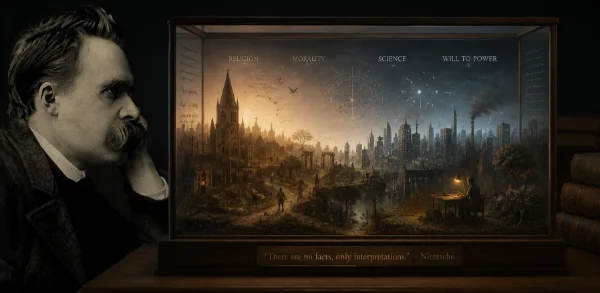
“There are no facts, only interpretations.”
The sentence is usually associated with Friedrich Nietzsche, and it has become one of those philosophical statements that people either admire immediately or reject as dangerous nonsense. Some hear liberation in it, while others hear relativism or intellectual irresponsibility, as though Nietzsche merely meant that truth dissolves into personal opinion and that every perspective is therefore equally valid.
But the sentence points toward something more unsettling than that. It questions whether human beings ever encounter a world in a purely neutral way at all.
The dioramic approach begins from a remarkably similar intuition. Not from the claim that reality is unreal, nor from the idea that everything is merely subjective fantasy, but from the observation that experience always already appears as something. What we call “the world” is never encountered raw or untouched. It arrives structured, organized, filtered, named, interpreted, emotionally charged, culturally shaped, and silently stabilized long before reflection begins.
In that sense, Nietzsche’s perspectivism and the dioramic view stand surprisingly close to one another.
Nietzsche did not simply argue that people have opinions about facts. He questioned whether facts can ever appear independently from interpretation in the first place. Every perception, every moral system, every philosophy, every religion, and every science emerges from within a perspective, a form of life, a constellation of values, instincts, assumptions, and necessities. There is no detached position outside life itself from which reality can be observed without mediation.
This resonates strongly with the dioramic insight that reality is always lived through a configuration. A world does not first appear neutrally and only afterward receive meaning through interpretation. Meaning is already woven into the appearance of the world itself. The obviousness of things, the relevance of distinctions, the sense of identity, the feeling of continuity, the boundaries between self and world, all arise together within a coherent experiential structure.
A diorama does not feel artificial from within. It feels real precisely because the elements reinforce one another continuously. A religious world, a scientific world, a political world, a depressive world, a romantic world, a nondual world, or a paranoid world do not simply consist of isolated beliefs added onto neutral reality afterward. They are experiential organizations in which perception, emotion, language, expectation, memory, interpretation, and identity form a mutually stabilizing whole.
Nietzsche saw something similar in morality and truth. What people call truth often turns out to be a stabilized interpretation that has forgotten its own origins. Concepts harden over time. Perspectives sediment. Metaphors become invisible through repetition. Entire civilizations begin treating historically grown interpretations as eternal reality. At that point, interpretation disguises itself as fact.
Where Nietzsche and the dioramic approach differ
Yet an important difference remains between Nietzsche and the dioramic approach.
Nietzsche’s thought is deeply psychological, existential, and often agonistic. Interpretation is tied to forces, instincts, domination, vitality, decadence, resentment, and the will to power. Perspectives struggle against one another because life itself is dynamic, unstable, and interpretive. His work frequently carries the atmosphere of confrontation and demolition, as though inherited certainties must first be shattered before something more honest can emerge.
The dioramic approach shifts the emphasis elsewhere. It is less concerned with who interprets and more interested in how a world becomes experientially coherent at all. Instead of asking which interpretation is correct, it examines how realities organize themselves from within experience and how they become convincing, inhabitable, and self-evident.
That difference changes the entire atmosphere of the inquiry.
Nietzsche often writes like a philosopher with a hammer. His work destabilizes inherited certainty, exposes hidden motives beneath moral ideals, and attacks the illusion of timeless truth. There is brilliance in that destruction, but also violence.
The dioramic approach moves differently. It is less iconoclastic and more observational. Rather than attempting to demolish worlds, it examines their architecture. It investigates how realities hold together, how they maintain coherence, what they foreground and background, how they produce identity, and how they generate the sense that “this is simply the way things are.”
The self inside the diorama
This also leads to another distinction. Nietzsche still often writes as though there exists an interpreter standing in relation to what is interpreted, even if that distinction becomes increasingly unstable in his work. In the dioramic perspective, even that separation begins to soften. The observer, the observed, the categories through which perception occurs, and the world that appears are intertwined within the same experiential configuration.
The self is not standing outside the diorama looking in from a neutral position. It is part of the structure through which the world becomes visible in the first place.
For that reason, the dioramic approach also resonates with thinkers such as Martin Heidegger, Maurice Merleau-Ponty, Ludwig Wittgenstein, Thomas Kuhn, Peter L. Berger, and Thomas Luckmann. In different ways, each questioned the fantasy of a purely neutral encounter with reality and showed how worlds are disclosed through structures of meaning, language, embodiment, practice, or historical context.
Yet the dioramic approach does not conclude from this that truth therefore disappears or that reality becomes arbitrary. Some experiential configurations hold together more powerfully than others. Some worlds are fragile. Some collapse under contradiction. Some produce blindness. Some narrow experience into rigid abstraction, while others open possibilities that previously remained invisible.
The point is not that everything becomes equally true.
The point is that reality is never encountered outside configuration.
This realization can initially feel destabilizing because human beings naturally seek foundations. We want certainty beneath interpretation, a final ground beneath perspective, an ultimate reality untouched by mediation. But perhaps the longing for an uninterpreted world is itself part of a particular experiential configuration. Perhaps even the desire for pure objectivity belongs to a historically shaped way of inhabiting reality that has become so familiar it no longer recognizes itself as one.
Nietzsche sensed this danger long ago.
The dioramic approach continues the investigation from another angle, not in order to deny reality, but in order to examine how realities become visible, coherent, convincing, and livable from within experience itself.
Leave a reflection
If this page prompted a thought, question or observation, you can send it to Wide Open Windows. Nothing is published automatically.