Few words in contemporary philosophy, psychology and spirituality seem as self-evident as consciousness. We speak of being conscious and unconscious, of states and contents of consciousness, of things entering consciousness or disappearing from it. We speak of expanded consciousness, higher consciousness, fields of consciousness and, increasingly, of awareness as the space in which experience appears.
The words differ, and the theories behind them may be radically opposed. A neuroscientist investigating consciousness is not necessarily talking about the same thing as a meditation teacher inviting us to rest in awareness. A psychoanalyst speaking about unconscious processes is doing something different again. Yet across these different traditions, a remarkably persistent image keeps returning.
Consciousness has a geography.
Something can be in consciousness or outside it. Something can emerge from the unconscious. Awareness can be wide or narrow, expanded or contracted. Memories can be buried deep within us. Spiritual insight can come from a higher level of consciousness. Thoughts, sensations and perceptions can arise in awareness. Consciousness itself can be described as a field, a space, a background or a container.
We use these expressions so easily that their strangeness has almost disappeared. But what exactly is this place?
A mind with rooms
Western psychology has a long history of spatialising the mind. Psychoanalysis made the distinction between conscious and unconscious processes enormously influential, and its language encouraged an almost geological imagination of the psyche. What is unavailable to consciousness lies somewhere beneath the surface. Memories are buried. Desires are repressed. Something hidden in the depths may rise into consciousness.
Freud's own models were more complicated and changed considerably over time, but popular culture turned the distinction into an extraordinarily durable picture. The mind became an iceberg: a small visible part above the water and an enormous invisible structure below.
Depth psychology made the metaphor explicit in its very name. Jung extended the territory beyond the personal unconscious into the collective unconscious. Later transpersonal psychologies added other regions and directions. In Roberto Assagioli's psychosynthesis, for example, the psyche could be represented as a structured field containing lower, middle and higher unconscious regions, a field of consciousness, a conscious self and a higher Self. The unconscious was no longer simply below. There was also something above us: the superconscious.
A psychology had become a landscape.
There is nothing inherently wrong with this. Models are useful precisely because they allow us to picture relationships that would otherwise be difficult to think about. A map of the psyche does not have to claim that the psyche literally consists of territories. The difficulty begins when we forget that we are looking at a map.
Once the spatial metaphor becomes familiar enough, it starts doing more than helping us think. It begins determining what there is to think about. We no longer merely speak as if memories were stored somewhere outside consciousness; we start wondering how they get back into consciousness. We ask what lies at deeper levels of the mind. We investigate what occupies the field of consciousness. Without any explicit decision having been made, the metaphor has begun to acquire the character of an ontology.
From depth to space
One might expect contemporary spirituality, particularly traditions influenced by Advaita Vedanta, to move away from this psychological geography. In one sense it does. The emphasis is no longer primarily on hidden contents beneath ordinary consciousness. Instead, attention shifts towards consciousness or awareness itself.
But the geography does not disappear. It changes shape.
Experiences are now said to arise in awareness. Thoughts appear and disappear within consciousness. Awareness is described as an open space in which perceptions, sensations and emotions come and go. Sometimes consciousness becomes a boundless field containing everything that appears. Sometimes it becomes the background against which experience unfolds.
The vertical geography of depth psychology has become a horizontal, or even boundless, geography of awareness.
This language can be experientially powerful. During meditation, for instance, the difference between being absorbed in a thought and noticing a thought can indeed feel like a change in spatial relationship. A thought that seemed to fill the world may suddenly seem small and transient, surrounded by something much larger. Describing this as space can be an effective way of pointing towards a recognisable shift.
But a subtle transformation can then occur. A metaphor for a way things seem becomes a description of how reality is structured. Awareness is no longer merely like an open space. It is the space in which everything appears. Consciousness is no longer a convenient term used to distinguish certain conditions or events. It becomes that which contains them.
From there it is a surprisingly small step towards metaphysics. If everything appears in consciousness, perhaps consciousness is more fundamental than the things appearing within it. If everything we can know appears in awareness, perhaps awareness is ultimate reality. If thoughts, bodies and worlds come and go while awareness remains, perhaps awareness itself is timeless, changeless and independent of everything appearing within it.
A grammatical construction has begun to tell us what reality consists of.
The innocent little word in
Perhaps the most revealing word in discussions about consciousness is not consciousness at all. It is in.
A thought appears in consciousness. A sensation arises in awareness. An image appears in the mind.
At first sight there seems nothing remarkable about these sentences. But compare them with ordinary spatial statements. The spoon is in the drawer. The fish is in the pond. The letter is in the envelope. Here the word in describes a relationship we readily understand: one thing is spatially contained by another.
But what kind of relationship is being described when we say that a thought is in consciousness? Where are the boundaries of the consciousness within which the thought appears? What would it mean for the thought to be outside it? And if something enters consciousness, where was it before?
The questions sound almost absurd, perhaps because the spatial metaphor was never meant to withstand them. It was a way of speaking. Yet surprisingly large philosophical claims can be built upon precisely this way of speaking.
We say that things appear in consciousness, observe that everything known to us appears in consciousness, and may eventually conclude that consciousness must therefore be the fundamental field or container of everything that can appear.
But part of the conclusion was already hiding in the preposition.
When a happening becomes a thing
There is another transformation taking place at the same time, and it is so ordinary that it is difficult to notice.
We see a red cup. We hear a dog barking. A knee hurts. A memory occurs. We become frightened, recognise a face, imagine tomorrow, wake from a dream. Something changes when anaesthesia takes effect and something changes again when we wake.
These are remarkably different happenings. Yet language allows us to gather them together under a single noun: consciousness.
There is nothing unusual about this. Language depends upon abstraction, and science could hardly function without turning processes, relations and regularities into nouns. But nouns have a peculiar gravitational pull. Once something has a name, it becomes remarkably easy to imagine that the name refers to a thing.
Being conscious becomes consciousness. Being aware becomes awareness. We can then ask where consciousness is located, what produces it, whether it has boundaries, whether it survives death, whether animals possess it, whether machines might acquire it, or whether it pervades the universe.
Perhaps some of these are meaningful questions. But before attempting to answer them, it may be worth noticing the linguistic transformation that made them possible. A collection of extraordinarily diverse happenings has acquired a name, and the name has begun to behave as though it refers to another phenomenon behind them.
That may be legitimate. There may indeed be something common to all these happenings that requires explanation. But naming the problem is not yet discovering the thing that explains it.
Consciousness in the laboratory
The problem is not confined to spirituality. Scientific research requires operational concepts, and consciousness can be perfectly useful as one. Researchers can investigate differences between wakefulness and anaesthesia, reportable and unreportable stimuli, perceptual processing with and without awareness, or neural activity associated with particular forms of perception.
Here the word does important practical work. But even scientific language can tempt us into reification. Information is said to enter consciousness. A stimulus reaches conscious awareness. Neural processes are described as giving rise to consciousness. Such expressions may simply be shorthand; a neuroscientist using them need not believe that there is a mysterious luminous container somewhere inside the skull.
Nevertheless, language matters because it helps determine the problem we think we are trying to solve. If consciousness has already been imagined as a distinct phenomenon that somehow appears when the correct neural conditions are present, the research question easily becomes: how does the brain produce consciousness?
But perhaps that formulation has already bundled together many different phenomena: seeing, sensing, attending, remembering, integrating, reporting, recognising, feeling, dreaming, locating oneself, experiencing duration and finding oneself in a world. Calling all of this consciousness may identify a genuine common problem, or it may conceal several different problems beneath one extraordinarily powerful noun.
Consciousness goes cosmic
The tendency to turn consciousness into something does not stop at the boundaries of psychology, neuroscience or spirituality. Panpsychism and related ideas have again become respectable subjects of philosophical discussion, and speculative proposals involving consciousness, information or experience occasionally reach into physics and cosmology as well. Consciousness, or some elementary precursor of it, can then be proposed as a fundamental feature of reality, perhaps comparable in some sense to the basic properties described by physics.
The attraction is understandable. If it seems impossible to explain how consciousness could emerge from entirely non-conscious matter, one possible response is to suppose that consciousness was there all along.
These proposals differ enormously, and it would be unfair to treat them as versions of the same doctrine. Nor does their speculative character make them wrong. Reality is under no obligation to conform to our present categories.
But something curious happens when consciousness enters the cosmos. The uncertainty surrounding the concept itself can disappear from view. We may have great difficulty defining consciousness, determining its boundaries or even agreeing about which phenomena the word refers to, yet nevertheless feel able to ask whether it is a fundamental property of the universe.
The question has thereby changed almost imperceptibly. Instead of asking what we are referring to when we use the word consciousness, we begin asking where consciousness belongs in our inventory of reality.
Panpsychism makes this especially visible. If consciousness cannot arise from matter, perhaps matter already possesses some rudimentary form of it. But what exactly has now been distributed across the universe? Sentience? Subjectivity? A capacity for feeling? Some elementary form of experience? Something that is not itself consciousness but can eventually become it? The further the concept is extended beyond the living beings in which the phenomena that prompted the concept are encountered, the harder it becomes to know what the word continues to mean.
There is a remarkable reversal here. A word connected with something extraordinarily intimate — seeing, hurting, dreaming, wondering, waking up — ends as the name of a hypothetical property of elementary systems or even the cosmos as a whole. What began close to home has become a cosmic ingredient, and the geography of consciousness has expanded until it potentially includes everything.
And what about experience?
There is an obvious escape route from all this. We can simply stop talking about consciousness and speak instead about experience.
This may seem safer. Rather than imagining consciousness as a container in which perceptions and thoughts appear, we can say that there is simply experience: seeing, hearing, thinking, sensing, remembering, dreaming. Consciousness is no longer required as a separate substance or field.
But the escape is not as easy as it looks.
Experience is also a noun, and it is subject to exactly the same gravitational pull. We can start by using it as a loose collective term for seeing, hearing, hurting, remembering and dreaming, only to find ourselves saying that experience is fundamental, that everything occurs within experience, or that reality consists of experience. At that point we may have done little more than replace one mysterious container with another.
Even the apparently modest statement there is experience deserves scrutiny. What precisely is being asserted? That something exists called experience? That all the different happenings we gather under this word share some fundamental property? That experience is ontologically prior to whatever is experienced?
None of this follows merely from the fact that words such as seeing, pain, dream, colour, thought and astonishment have something important in common for us.
This creates an awkward but productive difficulty. If consciousness may already contain a theory, experience may contain one too. Even experiencing, despite sounding more process-like, can begin to function as the name of a fundamental activity underlying everything else.
There may be no perfectly innocent vocabulary.
For an approach that begins with lived experience, this matters. To begin there need not mean declaring Experience to be the fundamental stuff of reality. It can mean something considerably more modest: beginning with what seems to be happening before deciding what kind of happening it is. Seeing, hearing, pain, memory, thought, body, self and world can be investigated as they present themselves without first placing them inside a container called consciousness, but also without placing them inside a larger container called experience.
Experience can remain a working word, a finger pointing towards the territory under investigation rather than the name of the substance from which that territory is made.
Losing the map
None of this demonstrates that consciousness does not exist, because that claim would merely reverse the metaphysics: we would first turn consciousness into a thing and then announce that the thing is unreal. Nor does it demonstrate that experience is somehow unreal, or that spatial metaphors should be abandoned. We could hardly think without metaphor, and spatial metaphors are among the most basic ways in which we make abstract relationships intelligible. We are close to someone, fall into depression, rise in status, leave the past behind and look forward to tomorrow. There is nothing suspicious about this until the metaphor ceases to be recognised as metaphor.
The same caution can be applied to consciousness, awareness and experience alike. Describing awareness as spacious may disclose something about a particular way of experiencing. Imagining unconscious processes as occurring beneath the surface may help us recognise aspects of ourselves that are not immediately accessible. Speaking of experience may allow us to indicate a bewilderingly diverse domain without repeatedly enumerating everything that happens there. These words and images can be useful precisely because they organise something that is otherwise difficult to talk about.
The difficulty begins when the organisation quietly acquires ontological weight. The space becomes something that actually exists, the depths become somewhere that things actually reside, consciousness becomes a field or fundamental property, or experience becomes the basic substance from which a lived world is supposedly made. What began as vocabulary for an investigation has then started supplying its conclusions.
Perhaps this is how a geography of consciousness comes into being. We encounter happenings that are difficult to describe and reach, quite naturally, for distinctions, nouns and spatial images. Those allow us to think and communicate; theories grow around them, and eventually the conceptual landscape becomes so familiar that its constructed character disappears from view. We begin investigating what lies beneath consciousness, what appears within it, how far awareness extends, whether consciousness is produced by brains or belongs to the universe itself. Even when we reject that geography and turn instead to experience, we may discover that we have already begun drawing another map.
The point is therefore not to find the one word that finally names what is really there. It may be more interesting to resist that urge for a while. Seeing happens, or seems to happen; pain hurts; thoughts come and go; dreams can become worlds; anaesthesia presents the astonishing possibility that even the apparent happening of anything at all can vanish. We can investigate all of this without knowing in advance whether it belongs to something called consciousness, whether it is made of something called experience, or whether either noun corresponds to a fundamental feature of reality.
Perhaps the most useful role for words such as consciousness and experience is therefore not to provide answers but to mark the places where our questions begin. The moment they start explaining what reality fundamentally is, it may be worth looking again at the map in our hands.
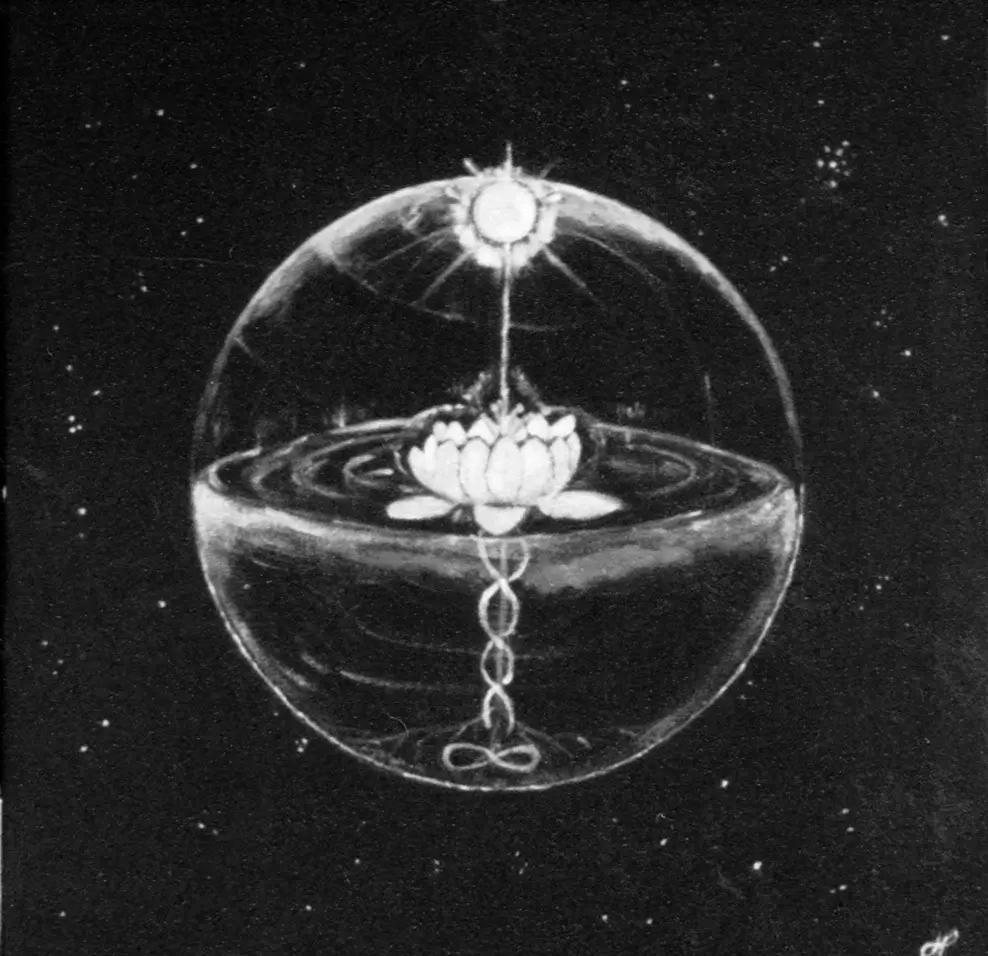
By the way, the painting that accompanies this article was made by me in 1978 after reading Roberto Assagioli, the inventor of psychosynthesis. If this page prompted a thought, question or observation, you can send it to Wide Open Windows. Nothing is published automatically.Leave a reflection