The books on this page were written at different stages in my thinking and my life. They explore questions about experience, reality and the ways we understand our existence. Some of these thoughts still resonate with me; others I would now express differently.
I leave them here side by side. Each book has its own perspective and coherence. Together, they offer glimpses of an inquiry that gradually changes direction and raises new questions.
How Lifeworlds Emerge
Ton Haarmans · English
How does a world emerge as a world? A central book in the Wide Open Windows project, exploring how the body, attention, language, memory and life with others give shape to our reality.
More about this book
How Lifeworlds Emerge may well be the central book in the Wide Open Windows project. Rather than asking what reality ultimately is, it poses a different question: how does a world emerge as a world?
Starting from everyday lived experience, Ton Haarmans traces how human reality gradually takes shape. Childhood, language, home, identity, culture, science, spirituality and everyday perception are explored as processes in which coherent worlds emerge. Reality appears here as something continually taking shape through the interplay of the body, attention, memory, language and social life, rather than as a fixed given.
The book introduces what Ton calls the dioramic approach. Just as a diorama brings diverse elements together into a meaningful world, human experience continually organises itself into worlds that feel natural, compelling and self-evident. Scientific, religious, political and personal realities are approached as different configurations rather than as competing descriptions of a single objective reality.
Along the way, the book enters into dialogue with phenomenology, constructivism, predictive processing, nonduality, neuroscience and contemporary physics. It keeps returning to the same fundamental question: how does experience organise itself into the worlds we live in?
How Lifeworlds Emerge does not aim to offer a definitive theory of reality. It invites closer attention to how realities emerge, persist, change and sometimes fall apart. In doing so, it opens up the possibility of approaching ourselves and others with greater curiosity and less certainty.

Living in Worlds
Dioramic Phenomenology
Ton Haarmans · English
How do the lifeworlds in which we think, feel and act come into being? This book explores how different configurations of experience shape what seems self-evident, meaningful and possible — and what this means for our understanding of one another.
More about this book
Living in Worlds explores what it means to inhabit a reality. Rather than treating people as observers of a single objective world, the book examines how each of us lives within a particular lifeworld, shaped by perception, language, memory, relationships, culture and personal history.
From everyday misunderstandings to ideological conflicts, from scientific inquiry to spirituality, the book shows how different worlds emerge, persist and interact. Disagreements rarely rest solely on different facts. People often live within different configurations of reality, which shape what seems self-evident, meaningful or even possible.
Through the dioramic approach, Ton Haarmans explores how lifeworlds influence our identity, communication, beliefs and social life. The book does not attempt to replace one worldview with another. It invites readers to recognise the worlds they already inhabit and to notice the remarkable diversity of human experience.
Living in Worlds is ultimately an invitation to greater curiosity, openness and intellectual humility. Recognising that we all live within worlds does not make reality less meaningful. It makes dialogue, discovery and change possible.

Reality
Ton Haarmans · English
What do we actually mean when we speak of reality? Reality explores how different conceptions of reality emerge, why they can be so compelling and how what seems self-evidently real can change.
More about this book
Reality explores one of philosophy’s oldest and most persistent questions: what do we mean when we call something real?
The book does not seek an ultimate foundation behind experience. It examines how different conceptions of reality arise and why they are so compelling to those who live within them.
Different conceptions of reality
Scientific realism, phenomenology, nonduality, idealism, materialism and everyday common sense are all considered. They are approached as different ways of ordering and understanding reality, without making any one perspective the absolute standard in advance.
This shifts attention from the question of which worldview is correct to the question of how a worldview acquires its persuasive force. What makes a particular representation so self-evident that it is barely recognisable as a representation at all?
How reality takes shape
Through the dioramic approach, Ton Haarmans examines how attention, language, memory, embodiment and culture contribute to what feels unquestionably real.
The focus is on how this coherence emerges, endures and changes. How does a conception of reality gain a foothold? How does it hold its ground? And what happens when familiar certainties cease to seem self-evident?
Continuing to question carefully
Reality invites us to loosen our attachment to familiar certainties while maintaining careful inquiry. Both scientific knowledge and philosophical wonder have a place here.
Every description of reality is itself part of the reality it attempts to describe. This book, too, looks from a particular position and thus remains implicated in its own inquiry.
Physics
An Analysis
Ton Haarmans · 2026 · English
Volume 3 of Analysis
From classical mechanics to relativity, quantum theory and cosmology, physics makes the universe intelligible with exceptional precision. But how does the scientific world in which this knowledge acquires meaning come into being? A dioramic exploration of the power and scope of thinking in physics.
More about this book
Physics is regarded as one of our most successful attempts to understand reality. Its theories predict eclipses, explain the structure of atoms, describe galaxies and make modern technology possible. Few intellectual endeavours have changed human life so profoundly.
The universe becomes intelligible
Physics. An Analysis first enters this scientific world on its own terms. The book follows the development of modern physics, from classical mechanics to relativity, quantum theory and contemporary cosmology.
It focuses on the concepts and models of thought through which the physical universe has become intelligible. Each development opens up new possibilities for describing phenomena, investigating relationships and testing predictions.
The scientific lifeworld
Attention then shifts to the coherence within which this knowledge emerges. From a dioramic perspective, physics is examined as a particular way of ordering experience. Concepts, mathematical models, experiments and instruments together form a world in which certain questions can be asked and answered.
This approach makes aspects of reality accessible with exceptional precision. At the same time, it has a particular scope: what can be measured, modelled and investigated experimentally takes centre stage. Other aspects of human experience fall outside this specific line of inquiry.
Appreciation and inquiry
The book does not dismiss the achievements of science. It examines how the worldview of physics itself takes shape and how its explanations acquire their coherence and persuasive force.
In this way, Physics invites a dual attention: to physics as one of humanity’s greatest achievements, and to the particular way a meaningful world appears within its concepts and practices.

Nonduality
An Analysis
Ton Haarmans · 2026 · English
Volume 2 of Analysis
What lies behind the claim that separation is an illusion? Nonduality explores the diversity of experiences, traditions and interpretations brought together under this name, and how they change the lived relationship between self and world.
More about this book
Few subjects evoke as much fascination, devotion, misunderstanding and controversy as nonduality. In spiritual traditions, contemporary teachings, psychology and philosophy, the term takes on a range of meanings. Behind the shared words lie different experiences and views.
The plurality behind the unity
Nonduality. An Analysis does not ask whether nonduality is ultimately true. It examines how nondual perspectives emerge, how they are interpreted and what they change in lived experience.
Classical traditions are placed alongside modern teachers. This reveals how many different approaches may lie behind the apparently simple claim that separation is an illusion.
Experience and interpretation
Through a dioramic approach, nonduality appears as a family of coherent configurations of experience. Different teachings illuminate different aspects of experience while also shaping worlds of their own: worlds of meaning, language, practice and identity.
Attention is therefore given both to what is experienced and to the concepts used to explain it. How does an experience acquire meaning within a tradition? And how does that explanation, in turn, influence the way someone experiences themselves and the world?
The appeal of nonduality
The book seeks to understand nonduality without defending or rejecting it. What do these perspectives make visible? How do they arise, and why do they exert such a strong appeal for people seeking to understand the nature of experience?
Nonduality explores these questions with attention to the diversity that can so easily disappear behind a claim to unity.

Language
An Analysis
Ton Haarmans · English
Language does more than describe what we experience. It directs our attention, draws distinctions and shapes what we can think and understand. An exploration of the role of language in the emergence of human lifeworlds.
More about this book
Language is so familiar that its influence easily goes unnoticed. We speak, read, write and think in words almost constantly. But language does more than convey thoughts. It organises perception, directs attention and provides the concepts through which experience becomes intelligible.
The world in words and signs
Language. An Analysis examines language as one of the forces through which human worlds emerge. Spoken and written language, inner speech, sign languages, symbols, mathematics and programming languages are considered as different ways in which meaning takes shape. The place of silence is also explored.
These forms of language offer different possibilities for making something visible, retaining it and sharing it. They influence what can be perceived, remembered, imagined, communicated and believed.
A dioramic approach
The book does not develop an all-encompassing theory of language, but approaches language through Dioramics. The question is how different forms of language configure experience and contribute to the coherence within which a world becomes meaningful.
Language appears here as more than a means of describing a reality already understood. It is also a condition of the way that reality becomes intelligible: how we draw distinctions, make connections and recognise something as something.
In this way, Language explores a remarkable human capacity: the use of words and signs through which we speak about the world while also contributing to the formation of the worlds we inhabit.
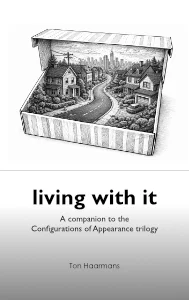
Living with It
A Companion to the Configurations of Appearance Trilogy
Ton Haarmans · 2026 · English
A companion to Configurations of Appearance
How do you go on living when the search for ultimate truths and higher standpoints loses its grip? Living with It brings the trilogy’s questions back to everyday life: to work, relationships, vulnerability and the making of small worlds that hold together for a while.
More about this book
Living with It brings together the central ideas of This Is It, Mindsets and Origins in a more direct, personal and practical form. It asks what it means to live when the desire for a definitive foundation begins to diminish.
A landscape of experiences
The book approaches experience as a landscape of different configurations. The everyday world, scientific explanations, spiritual experiences and dreams each have their own coherence. None is placed above the others in advance.
Their differences do not disappear as a result. Some worlds are stable and widely shared; others are fragile or short-lived. Some support action; others intensify suffering. What is questioned is the assumption that one perspective can serve as the ultimate standard for all the others.
The diorama as a starting point
The central image is the diorama. Cardboard, paper, objects and light come together in a scene in which depth, distance and meaning emerge. For a moment, you are looking at a landscape rather than a box.
A lifeworld, too, takes shape through coherence: memories, expectations, attention and distinctions help determine what appears near or far, important or unimportant. Stepping out of one diorama does not yield a view from nowhere. The space around the diorama is itself another world in which we find ourselves.
The book includes itself in this. It is a temporary environment of words and images in which the reader is invited to look around.
Worlds from within
Much of Living with It describes how different lifeworlds feel when they are active. The familiar world of arrangements and everyday activities stands alongside the scientific world of measurement and explanation, and the therapeutic world in which events are understood through a personal history.
The intensity of a finely attuned experience sensitive to sensory stimulation is also considered, as are spiritual and nondual experiences. Other chapters explore the world of the child, virtual environments and dreams.
These descriptions convey how different worlds can appear within a single life. The transitions are often barely perceptible. What was urgent loses its importance. What seemed abstract suddenly becomes self-evident.
At the edges of orientation
The book also explores experiences in which our usual bearings grow faint or disappear. Headlessness, emptiness and darkness are described without elevating them to higher realities.
The chapter on death brings the inquiry to a personal limit. No metaphysical reassurance is offered. Fear, uncertainty and bodily finitude are given their place, without being dissolved into a doctrine about what must ultimately exist.
The workshop
A website, book, room, routine, friendship or conversation can be seen as a workable world: a temporary coherence within which something becomes possible. Such a world does not need to be valid for all time to be meaningful.
The maker makes adjustments. A paragraph becomes shorter, an image moves, a menu becomes simpler. A chair is added; a distracting element is removed. Life takes on something of a workshop in which things are tried, noticed and adjusted.
This applies to writing itself. Tone, rhythm, images and thoughts are arranged so that a text can hold together for a while. What has already been made does not therefore have to be preserved forever.
Living together without an ultimate ground
The absence of an ultimate foundation does not remove care and responsibility. People help, apologise, restore trust and try to prevent harm. The consequences of their actions remain tangible.
Ethics here takes the form of attention to a shared world that can be damaged. What makes a situation more liveable? What increases mistrust or pain? What can be repaired? Such questions remain important, even without cosmic justification.
Nor does the provisional character of lifeworlds mean that everything is interchangeable. Bodies need food and sleep. Environments can support or exhaust us. Some solutions work; others keep meeting the same resistance.
Attention on a human scale
The book ultimately returns to ordinary activities: making coffee, letting the dogs out, looking at the weather and moving words around on a page. These moments do not need to reveal a hidden truth to be worth attending to.
A room can become simply a room again. A mood does not immediately have to carry a judgement on an entire life. Problems can lose some of the extra weight that comes from comparisons and images of how life ought to have been.
This attention is not a lasting state. It is forgotten and interrupted. Nothing definitive has been achieved. Sometimes, what is happening is simply noticed again.
Living with It thus brings the trilogy’s questions back to the life in which they arise: a workshop of attention, adjustment and small worlds that hold together for a while.
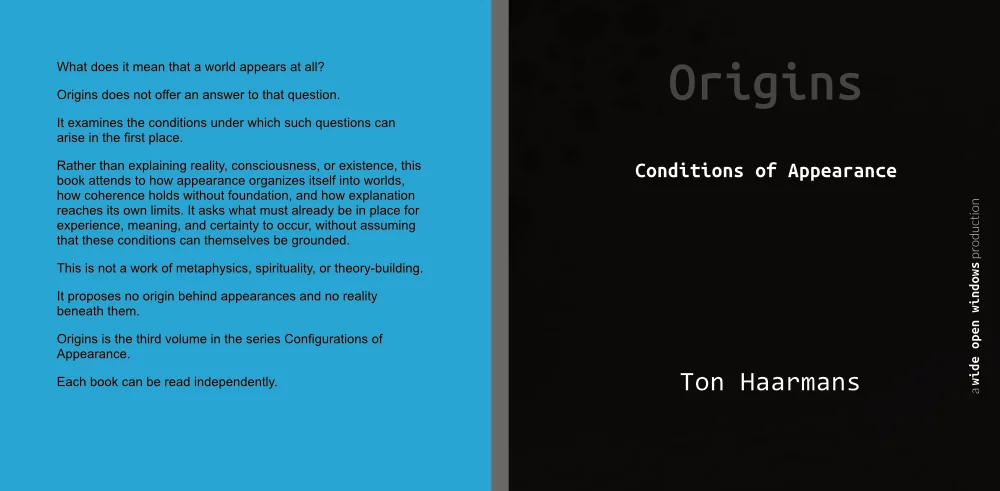
Origins
Conditions of Appearance
Ton Haarmans · 2025 · English
Volume 3 of Configurations of Appearance
What makes it possible for a world to appear at all? Origins explores how difference, repetition and coherence take shape as things, identity and meaning. An exploration of the conditions of experience and the limits of explanation.
More about this book
Origins is the third and final volume of Configurations of Appearance. While This Is It starts from the immediacy of experience and Mindsets maps different worlds of experience, this book asks about the conditions under which a world, an experience or a subject can appear.
Origin as condition
The title does not refer to a first moment in time, a cosmic beginning or a hidden substance. It concerns origin as condition: what makes it possible for something to become recognisable, to persist and to acquire meaning?
The book examines appearing before it is understood as a self-evident world of objects, events and observers. This ‘before’ does not point to a distant past. It refers to the conditions at work when a world takes shape.
How coherence emerges
A world becomes coherent when differences become recognisable, patterns recur and expectations become possible. Something persists long enough to be recognised as the same. This is distinguished from that, here from there, a self from its surroundings.
Through repetition and mutual reinforcement, such distinctions can begin to feel self-evident. What reliably recurs seems necessary. But, the book argues, this experienced necessity does not prove that an ultimate ground underlies the coherence.
The concept of worlding shifts attention to the continual emergence and persistence of this coherence. A world appears stable because patterns, distinctions and expectations keep supporting one another.
Conditions and causes
Within a world, causal explanations are indispensable. They help us understand events, make predictions and act purposefully. But such explanations already presuppose a coherence within which time, succession and regularity have meaning.
Origins therefore distinguishes between causes and conditions. A cause explains an event within a particular framework. An inquiry into conditions asks what makes that framework possible.
The value of scientific explanations remains intact. The book questions the move by which an explanation within the world is extended into an ultimate explanation of the appearing of a world as such.
Experience, too, has conditions
Experience seems a certain starting point: whatever we doubt, something is being experienced. Yet the book also examines experience as an outcome of ordering. There must be sufficient distinction and continuity for something to be experienced as something.
The subject is not presented here as an already existing recipient of impressions. The sense of a self arises within the same coherence in which surroundings, a past and expectations also become recognisable.
This also calls experience into question as a possible ultimate ground. Its immediacy does not automatically make the conditions of its appearing accessible.
Without an ultimate foundation
Philosophical, scientific and spiritual explanations often seek something on which everything else ultimately rests. But every ground that is named itself appears as a concept, model or thought within the world it is meant to explain.
According to Origins, this does not mean that coherence is absent. Patterns can endure, explanations can work and meaning can persist. What remains out of reach is a definitive justification of the whole.
When explanation reaches its limit, no hidden truth is thereby revealed. There is no need to assume a deeper reality beyond that limit. Sometimes there is simply no further explanation available.
No view from outside
This inquiry, too, takes place from a particular position. What is visible, intelligible or relevant depends on the conditions under which we look. Removing every perspective would not automatically yield a pure view of reality.
This does not erase differences between explanations. Some are more precise, better supported or more useful than others. But the criteria by which we judge this also have meaning within human practices of inquiry.
The book makes no exception for itself. Its own concepts and arguments also belong to the field it attempts to investigate.
After the worlds
In its closing movement, Origins explores what happens when the need to bring everything into one definitive whole diminishes. Worlds continue to appear. Meaning, explanation and orientation return.
No final state or spiritual attainment is proposed. Nor are the conditions of appearing turned into a new foundation after all.
In this way, Origins concludes the series with an inquiry into the limits of theorising. Every origin that can be named has already found a place within a world.
Mindsets
A Cartography of Experience
Ton Haarmans · 2025 · English
Volume 2 of Configurations of Appearance
How can the same world appear so differently? Mindsets explores the often unnoticed patterns through which experience becomes coherent. A provisional map of lifeworlds, their overlaps and shifts, without identifying a highest or definitive way of experiencing.
More about this book
Mindsets is the second volume of Configurations of Appearance. It examines the structures through which a world becomes visible, meaningful and real. The book can be read on its own.
Unnoticed coherence
A mindset here is not an attitude, personality type or consciously chosen philosophy of life. The term refers to the way experience organises itself at a particular moment: what stands out, what remains in the background, what seems self-evident and which possibilities are visible.
We do not first encounter a neutral world and then begin to interpret it. When something appears, perception, memory, expectation, language and bodily sensitivity have already contributed to the coherence within which it is experienced. The sense of being a self that acts and has a history is part of this too.
This ordering has no separate designer. It becomes recognisable above all through its effects: what can be questioned, what seems unthinkable and what goes entirely unnoticed.
A map without fixed boundaries
The book approaches mindsets as terrains that flow into one another. The same person may live practically and purposefully in one situation, analytically, narratively, religiously or spiritually in another. Different patterns can operate simultaneously and even contradict one another.
The lifeworlds described draw their coherence, for example, from shared expectations, from what works in practice, from explanations, from a personal story or from a religious order. Other descriptions focus on the role of sensory intensity and sensitivity to the environment.
The map is intended to make recurring patterns visible. It does not divide people into fixed categories or establish a standard to which every experience should conform.
Worlds under pressure
Mindsets also explores what happens when familiar coherence comes under pressure. Trauma, dissociation, mania and depression are discussed through the question of how danger, distance, speed or a loss of meaning can shape the experienced world.
The book seeks to avoid both condemnation and romanticisation. What seems incomprehensible from the outside may feel necessary from within. At the same time, disruption is not automatically a spiritual insight.
Experiences under the influence of substances are also considered. An intense change in perception and meaning may be experienced as a revelation. But the compelling nature of such an experience does not, in itself, prove that a hidden reality has been revealed.
Nonduality and the loss of bearings
Nonduality is first examined as a possible configuration of experience: a world in which the opposition between subject and object loses its force and no separate centre is experienced.
Later, under the name the unframed, the book explores experiences in which familiar orientation itself falls away. Headlessness, emptiness and darkness are described from different perspectives.
These experiences, too, are not placed above the others. They are examined because they occur and raise questions about the structures that ordinarily provide direction and coherence so self-evidently.
Change without a final destination
A change of mindset need not be progress towards a higher consciousness. A later lifeworld does not necessarily include or transcend an earlier one. What seems important, credible and possible is reordered.
Such a shift may be associated with a crisis, fatigue, persistent contradiction, reflection or an encounter with another lifeworld. There is no predetermined direction. Experience may broaden, narrow, fall apart or stabilise again.
This does not make differences unimportant. A particular coherence may be helpful in a situation or may cause harm. Such differences call for attention, without requiring a hierarchy of ultimate truth.
Standing alongside another world
Misunderstandings easily arise when one lifeworld judges another by its own unspoken standards. Even well-meant advice can miss its mark as a result. ‘Let go’, ‘think rationally’ or ‘be present’ presupposes possibilities that may not be available to the other person at all.
The book therefore explores standing alongside one another: remaining present to another lifeworld without immediately reducing it to one’s own concepts. This does not mean agreeing with everything that happens, but exercising restraint in assuming that every difference needs to be corrected or resolved.
The mapmaker stands within the landscape
No overview of mindsets can be complete. New forms of coherence emerge and existing ones change. The mapmaker, too, looks from a particular lifeworld. There is no neutral vantage point from which all other worlds can be definitively surveyed.
Mindsets therefore offers no method for choosing the best mindset. It offers a language for noticing how experience organises itself, how temporary worlds acquire authority and how easily one world is mistaken for the world.
This Is It
How the World Shows Up as Experience
Ton Haarmans · 2025 · English
Volume 1 of Configurations of Appearance
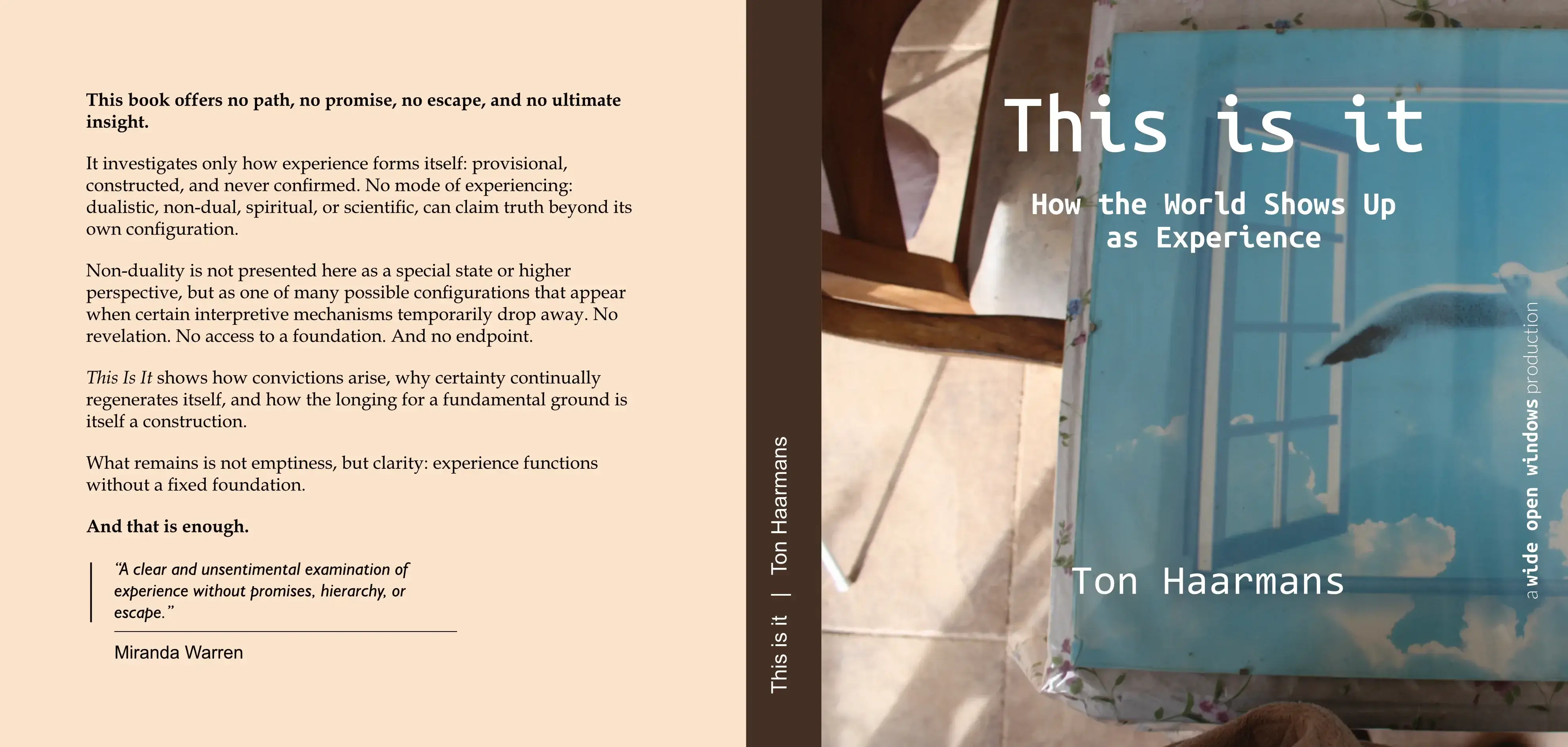
Everything we know appears within experience. But what does that experience tell us about reality? An inquiry into the emergence of a meaningful world, the appeal of spiritual certainty and the possibility of living without ultimate answers.
More about this book
This Is It is the first volume of Configurations of Appearance. This series explores different ways in which experience organises itself, without assuming that any one of them offers privileged access to reality. Each volume approaches the same field from a different angle and can be read on its own.
How a world appears
The book begins with a simple observation: everything we know about ourselves, others, the world or consciousness appears within experience. We may assume that something exists independently of us, but we always encounter it as it is perceived, selected and interpreted by a living organism.
Perception, memory, expectation, language, bodily sensations and social learning come together in a world in which we can act. That world feels immediately given, even as it is continually being shaped. Experience shows us the result; its ultimate origin remains out of reach.
This does not mean that the world is unreal or that every interpretation is equally valid. Construction is not the same as illusion. The experienced world is neither a transparent copy of reality nor an arbitrary fantasy. It is limited and provisional, and usually reliable enough to live in.
No higher state
From there, the book examines experiences often considered exceptional: nonduality, mystical experiences and so-called awakening. Such experiences can profoundly affect, unsettle or liberate us. Yet they, too, remain configurations of experience. The falling away of the familiar separation between an inner observer and an outer world does not establish what reality ultimately is.
Nor does an experience contain a ready-made explanation of itself. Its meaning takes shape through memories, expectations, cultural concepts and the stories available within a community. A change in experience may thus be interpreted as a revelation, a stage on a spiritual path or evidence for a metaphysical doctrine.
A central theme is therefore the tendency to rank experiences and people: higher, deeper, more awakened. Intensity or relief is easily confused with truth. In response, the book offers the image of a landscape: different ways of experiencing, without a single summit where definitive insight awaits.
Thought as it is lived
Between the philosophical chapters are autobiographical interludes about studying philosophy in Amsterdam, encountering Castaneda, the years in the Rajneesh movement and the later search within advaita and neo-advaita. They show how ideas can organise a life: how longing turns teachers into masters and how the promise of a final answer can provide direction for years.
These experiences are not dismissed as meaningless. What is questioned is the claim that they give access to a higher order of reality. The search ceases to seem self-evident when it becomes apparent how it continually reproduces itself.
Living without an ultimate ground
The absence of metaphysical certainty need not make life impossible. People act, care, create and maintain relationships without possessing an ultimate explanation of their existence. Experience becomes coherent through provisional patterns that can be adjusted and corrected.
This Is It brings phenomenological reflection, cognitive science, constructivism, nonduality and personal history into dialogue. Contemporary voices such as Robert Saltzman, Joan Tollifson, Miranda Warren and Shiv Sengupta also play a part.
The mystery of existence remains. What may diminish is the demand that it must first be solved before life can be lived.