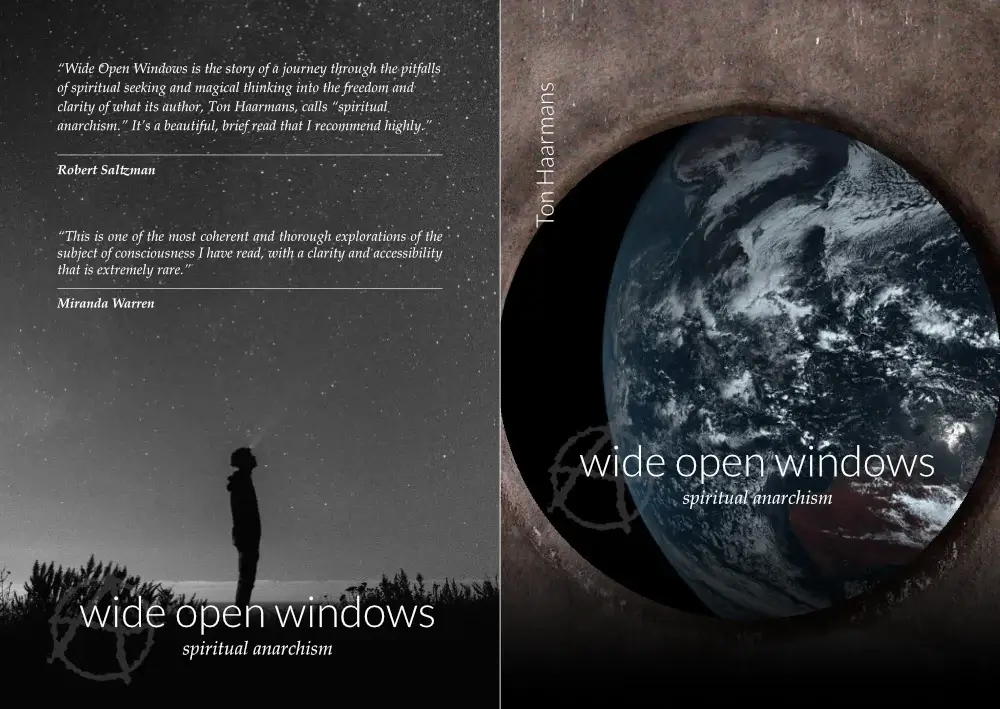
Spiritual Anarchism marks an important turning point in the development of the ideas that would eventually become Wide Open Windows. While earlier work focused on the question of what can truly be known, this book shifts attention toward the beliefs, assumptions and authorities that quietly shape our experience long before we become aware of them.
The title is easily misunderstood. It has nothing to do with politics, social ideology or rejecting society. Instead, it points to a radical inner freedom: the willingness to question every inherited certainty, every spiritual doctrine and every conceptual framework—including one's own. It asks what remains when there is no authority left to tell us what reality is, who we are, or how life should be lived.
The book grew out of many years of involvement with non-duality, meditation and spiritual traditions. Rather than dismissing these paths, it examines the tendency of every tradition to become another belief system. The invitation is not to replace one philosophy with another, but to discover whether experience itself requires any philosophy at all.
Looking back, I see this book as the bridge between my earlier investigations into knowledge and the later Dioramic Approach. Many themes that would become central to Wide Open Windows already appear here: the absence of fixed truths, the questioning of the separate self, the rejection of spiritual hierarchy, the recognition that experience cannot be forced, and the growing fascination with how reality appears rather than what reality ultimately is.
Today I would formulate some of these ideas differently. The language of Spiritual Anarchism is sometimes deliberately provocative, and later I became more interested in describing the emergence of lived worlds than in dismantling beliefs. Yet the underlying impulse remains exactly the same: to meet experience without prematurely explaining it.
"What remains when every authority—including the authority of your own beliefs—has quietly fallen away?"
That question still lies at the heart of Wide Open Windows. The investigation has changed direction over the years, but not its spirit: an ongoing willingness to remain open, to question certainty, and to let experience speak before thought claims to understand it.
Download a copy on the [[/content/resources/downloads|download page]] of this project or order a Kindle e-book from Amazon.
Leave a reflection
If this page prompted a thought, question or observation, you can send it to Wide Open Windows. Nothing is published automatically.