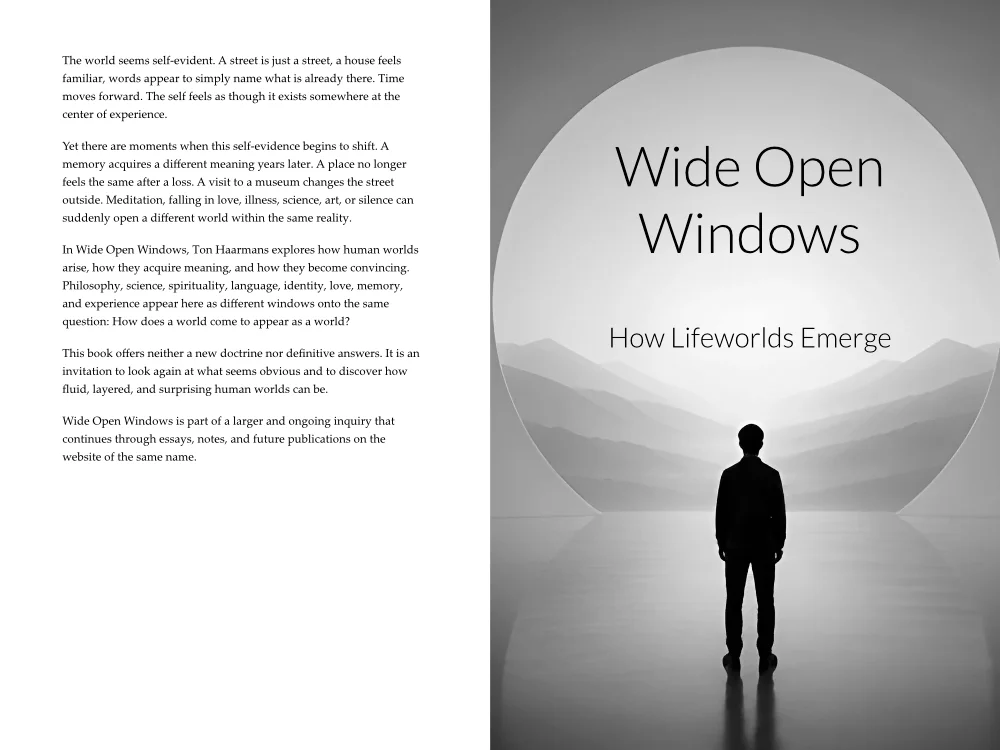
How Lifeworlds Emerge is perhaps the central book of the Wide Open Windows project. Rather than asking what reality ultimately is, it asks a different question: how does a world come to appear as a world?
Starting from ordinary lived experience, Ton Haarmans follows the gradual formation of human reality. Childhood, language, home, identity, culture, science, spirituality and everyday perception are explored as processes through which coherent worlds emerge. Reality is presented not as a fixed given, but as something that continuously takes shape through the interaction of body, attention, memory, language and social life.
The book introduces what Ton calls the Dioramic Approach. Just as a diorama creates a meaningful world by arranging many different elements into a coherent whole, human experience continually organises itself into worlds that feel natural, convincing and self-evident. Scientific, religious, political and personal realities are approached as different configurations rather than competing descriptions of a single objective reality.
Along the way, the book engages with phenomenology, constructivism, predictive processing, non-duality, neuroscience and contemporary physics, always returning to the same fundamental question: how does experience organise itself into the worlds we inhabit?
How the World Emerges is not intended as a final theory of reality. It is an invitation to observe more carefully how realities arise, stabilise, transform and sometimes dissolve, opening the possibility of seeing both ourselves and others with greater curiosity and less certainty.
Download this book (EN or NL) as PDF on the [[/content/resources/downloads|download page]] of this project
Leave a reflection
If this page prompted a thought, question or observation, you can send it to Wide Open Windows. Nothing is published automatically.